
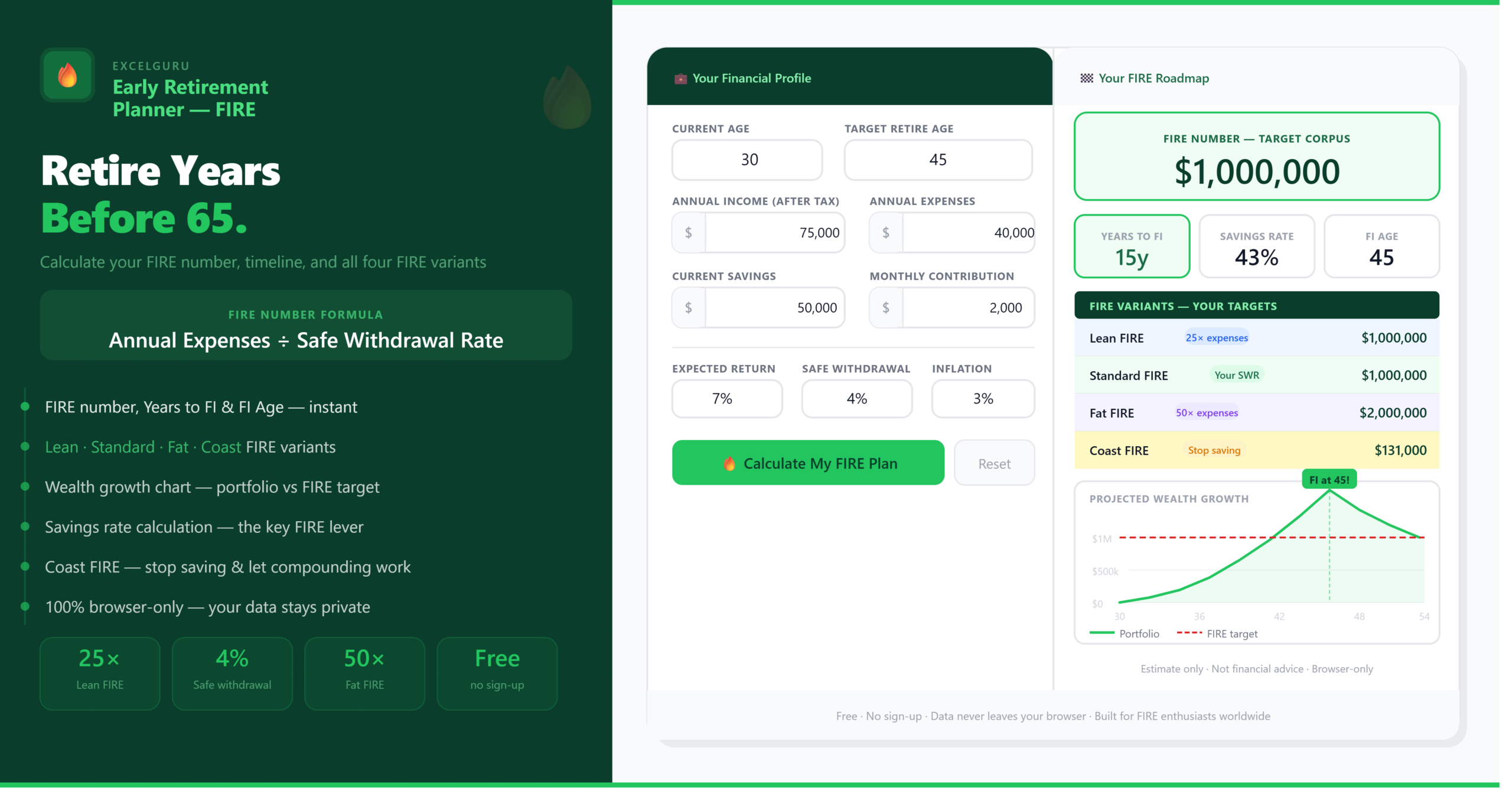
Enter your financial details on the left — your personalised FIRE roadmap appears here instantly.
✓ Years to financial independence
✓ Savings rate
✓ Lean, Standard, Fat FIRE targets
✓ Coast FIRE number
✓ Wealth growth projection
Projections assume constant returns and contributions. Actual results will vary based on market conditions, taxes, and personal circumstances. This is an estimate — not financial advice.
How to Use the Early Retirement Planner
Five straightforward steps — no account, no uploads, no data sent to any server. Your result appears as soon as you enter your details.
Enter Your Financial Details
Start with your current age and the retirement age you are aiming for. Then add your annual after-tax income, your current annual expenses, and your existing investable savings. Be as accurate as possible — these inputs have the biggest effect on your result. Do not include home equity unless you plan to sell and downsize.
Set Your Monthly Contribution
Enter how much you save and invest each month on top of your existing balance. This figure drives your savings rate — the single most powerful lever in early retirement planning. Even a small increase in monthly contributions can shave several years off your timeline. Try adjusting this number to see the impact immediately.
Set Your Assumptions
Choose your expected annual return (7–9% is historically reasonable for diversified index funds), your safe withdrawal rate (4% is the standard starting point, though 3.5% is safer for retirements lasting 50+ years), and the inflation rate you want to plan for. These three inputs shape the entire projection, so use conservative estimates if you want a more cautious plan.
Review Your FIRE Roadmap
Once you click Calculate, the right panel shows your full FIRE roadmap. You will see your FIRE number (the total corpus needed to retire), your projected years to financial independence, your savings rate, and targets for Lean, Standard, Fat, and Coast FIRE. The wealth growth chart shows how your portfolio compounds year by year toward the target.
Iterate and Explore Scenarios
Real value comes from experimenting with your inputs. For instance, try increasing your monthly contribution by $500. Alternatively, try lowering your annual expenses by $5,000. Notice how dramatically each change affects your timeline. This kind of scenario testing, in fact, helps you find the combination of habits and targets that feels both achievable and motivating for your specific situation.
Check Your Coast FIRE Number
In particular, Coast FIRE is a milestone worth checking early. If your current savings already exceed your Coast FIRE number, you could stop contributing today and still reach full FIRE by traditional retirement age. Many people find they are closer to this milestone than they expected — and it can be a powerful motivator to push further.
The Complete Guide to Early Retirement Planning (2026)
Everything you need to understand FIRE — from the core formula to savings rate math, risk, and withdrawal strategies — explained clearly for anyone starting out or refining their plan.
What is FIRE and who is it for?
FIRE stands for Financial Independence, Retire Early. At its core, the movement is about reaching a point where your investment portfolio generates enough income to cover your living expenses permanently — without needing to work. The traditional retirement age of 65 was designed for an earlier era with different life expectancies, career structures, and financial products. Today, with low-cost index funds and clear mathematical frameworks, financial independence is achievable for people across a wide range of incomes — not just the wealthy.
Importantly, FIRE is not about stopping all productive activity. Many people who reach FI continue to work on things they care about. The key difference is that work becomes optional. That shift — from financial necessity to genuine choice — is what the movement is ultimately about.
The FIRE number — how much do you actually need?
Your FIRE number is the total portfolio value you need to retire safely. The formula is simple: FIRE Number = Annual Expenses ÷ Safe Withdrawal Rate. If your annual expenses are $40,000 and you use a 4% withdrawal rate, your FIRE number is $1,000,000. That portfolio, growing at a long-term real return, should sustain withdrawals indefinitely without depleting the principal.
Furthermore, the FIRE number is sensitive to two inputs above all others — your annual expenses and your withdrawal rate. Consequently, reducing expenses by $10,000 per year does not just lower your annual costs; it also reduces the total corpus you need to accumulate. This double effect is why frugality is so powerful in the FIRE framework.
The 4% rule originates from the Trinity Study, a 1998 analysis of US market data. Researchers found that a portfolio invested in a mix of stocks and bonds could sustain a 4% annual withdrawal for at least 30 years in almost all historical market conditions. For early retirees planning 40–50 year retirements, many planners now recommend 3.5% or 3.25% for an extra margin of safety. Use the SWR field in this calculator to adjust accordingly.
Savings rate — the most powerful variable in your plan
Your savings rate — the percentage of your income you save and invest — is, in fact, the single biggest driver of how quickly you reach FIRE. The maths are striking. At a 10% savings rate, retirement takes roughly 50 years. Moving to 30% cuts that to around 28 years. Reaching 50% brings the timeline down to about 17 years. At 70%, you are looking at just 8 years. These figures assume typical long-term market returns.
Crucially, every extra dollar you save works in two ways at once. First, it grows your investment balance directly. Second, it reduces your spending baseline — and therefore your FIRE number. This compounding effect means that increasing your savings rate has a non-linear impact on your timeline. In practice, the most reliable way to raise your savings rate is to keep expenses low as income grows, rather than spending more as you earn more.
Understanding the four FIRE variants
The FIRE community has developed several sub-paths to suit different lifestyle goals and risk tolerances. Each variant defines a different target and a different retirement lifestyle.
- Lean FIRE targets 25× annual expenses and suits people who are comfortable with a frugal or minimalist lifestyle — often digital nomads or those living in low-cost locations.
- Standard FIRE uses your chosen withdrawal rate (typically 3.5–4%) and represents the most common path. It allows a comfortable but not extravagant lifestyle.
- Fat FIRE targets 50× annual expenses and provides for generous, comfortable spending in retirement — typically $100,000 or more per year.
- Coast FIRE is the amount you need invested right now so that, without adding another dollar, compound growth alone will carry you to full FIRE by traditional retirement age. It is a powerful milestone because it means the accumulation work is done — you only need to cover your current expenses.
The formula is: Coast FIRE = FIRE Number ÷ (1 + annual return)^(years until age 65). For example, if your FIRE number is $1,000,000, your return is 7%, and you are 35 (30 years to 65), your Coast FIRE number is roughly $131,000. If you already have that invested and never add another dollar, compound growth does the rest. This calculator computes this figure automatically once you enter your details.
Sequence of returns risk — the biggest threat to early retirees
Sequence of returns risk is, specifically, the danger of experiencing poor market returns in the early years of retirement. Even if long-term average returns are strong, a significant market decline in your first few years of withdrawal can permanently impair your portfolio — because you are selling assets at depressed prices to fund living expenses, leaving less capital to participate in the eventual recovery.
Moreover, this risk is particularly relevant for early retirees, whose retirements can span 40–50 years. To mitigate it, consider holding one to three years of expenses in cash or short-term bonds at retirement, so you do not need to sell equities during a downturn. Alternatively, using a slightly lower withdrawal rate — 3.5% rather than 4% — builds in a meaningful buffer against bad sequence outcomes.
Tax-efficient strategies for early retirees
Accessing retirement accounts before the traditional withdrawal age of 59½ requires planning to avoid early withdrawal penalties. Three strategies are commonly used. First, the Roth Conversion Ladder involves converting traditional IRA funds to a Roth IRA over several years, paying income tax on each conversion, and then accessing the converted amounts penalty-free after a five-year waiting period. Second, 72(t) SEPP (Substantially Equal Periodic Payments) allows penalty-free withdrawals from an IRA using a fixed distribution schedule. Third, a well-funded taxable brokerage account can bridge the gap, since long-term capital gains are taxed at 0% for lower income levels — a significant advantage for early retirees with modest withdrawal amounts.
A worked example — retiring at 45 on a $75,000 income
Consider someone aged 30 with a $75,000 after-tax income, $40,000 in annual expenses, $50,000 in current savings, and a $1,500 monthly contribution (a savings rate of 24%). With a 7% return and a 4% withdrawal rate, their FIRE number is $1,000,000. At this rate, they reach FI at around age 52 — a 22-year timeline.
However, if they increase their monthly contribution to $2,500 (a 40% savings rate), the timeline shortens to around 14 years — reaching FI at age 44. Alternatively, if they also grow their income to $100,000 while keeping expenses at $40,000, the savings rate rises to 60% and FI arrives in roughly 10 years, at age 40. This example illustrates how powerfully income growth and expense control interact to accelerate the timeline.
The most frequent planning errors are using overly optimistic return assumptions (use 5–6% real, not 8–10% nominal), ignoring healthcare costs (add $5,000–$10,000 per year in the US), forgetting lumpy expenses such as car replacements and home repairs, and failing to account for inflation eroding purchasing power over a 40-year retirement. Each of these can add years to your required working life if left unaddressed.
Frequently Asked Questions
Clear answers to the most common questions about early retirement planning and the FIRE movement.