
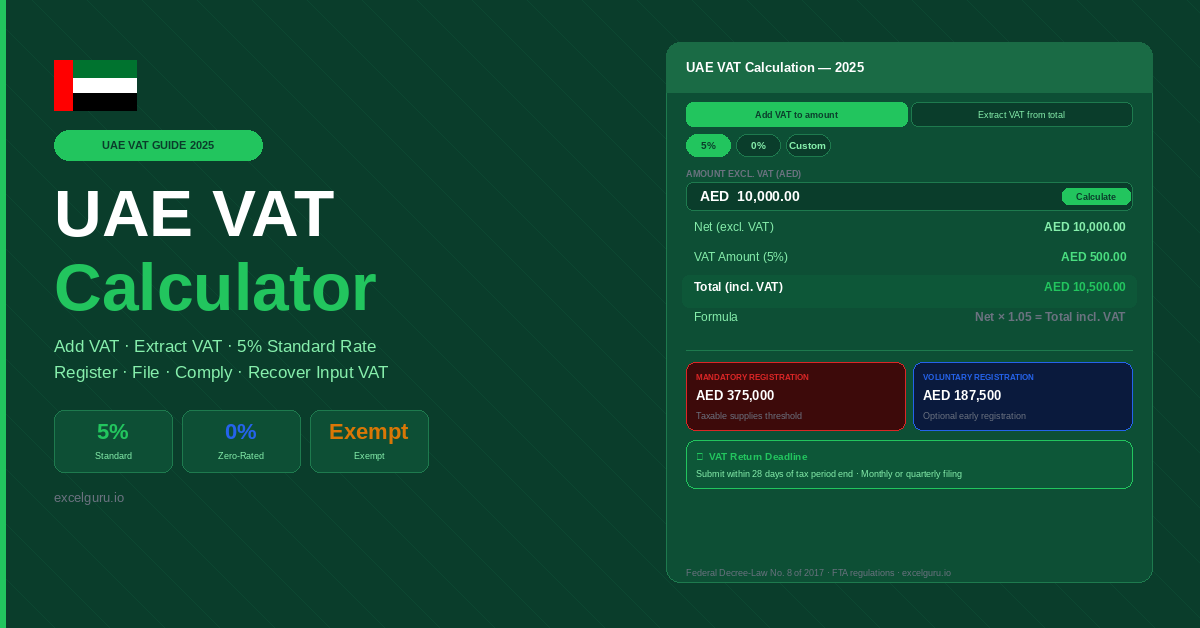
Select a mode, enter an amount, and click Calculate to see the VAT breakdown — net amount, VAT, and total with full workings shown.
How to Use the UAE VAT Calculator
Calculate UAE VAT instantly — add 5% to a net amount, extract VAT from a VAT-inclusive total, or use a custom rate for other GCC jurisdictions. Results include full workings and a downloadable CSV.
Choose your calculation mode
Add VAT to amount — enter the net price excluding VAT. The calculator adds 5% and shows the total. Use this when quoting a customer or raising an invoice.
Extract VAT from total — enter the VAT-inclusive total. The calculator works backwards to show the net and the VAT element. Use this when reconciling a supplier invoice or verifying VAT paid.
Set the rate and enter the amount
Select 5% for the standard UAE VAT rate. Choose 0% for zero-rated supplies such as exports. Use Custom for other GCC rates — Oman, Bahrain, Saudi Arabia, and Qatar each have their own applicable rates. Enter the amount in AED and press Calculate. Quick-example buttons pre-fill common invoice amounts for speed.
Read results and export
Results show the net amount, VAT element, and VAT-inclusive total — with the full formula workings in the breakdown panel. Click Download Breakdown to export a CSV file for bookkeeping, VAT return reconciliation, or sharing with your accountant. All figures are shown to two decimal places in AED.
When a supplier invoice shows a VAT-inclusive total of AED 5,250, the VAT element is not AED 250 (5% of 5,250 = AED 262.50). Use Extract mode: AED 5,250 ÷ 1.05 = AED 5,000 net + AED 250 VAT. Switch to Extract VAT from total mode to get the correct figures for input VAT recovery claims.
UAE VAT Guide 2025 — Rates, Registration, Filing, and Compliance
Everything businesses operating in the UAE need to know about VAT — from the three supply categories and registration thresholds to input VAT recovery, filing deadlines, and FTA penalties.
UAE VAT — the three supply categories
UAE VAT operates under three distinct supply categories, each with different VAT treatment. Understanding the difference between them is fundamental to correct VAT accounting and input VAT recovery.
VAT charged at 5%. Input VAT on related costs is fully recoverable. Applies to the majority of goods and services supplied in the UAE.
Restaurant meals · Trading · Digital services
VAT charged at 0% — but input VAT on related costs remains fully recoverable. This is the key distinction from exempt supplies.
New residential property · Healthcare · Education
No VAT charged — and businesses cannot recover input VAT on costs directly attributable to exempt supplies. Partial recovery applies for mixed businesses.
Bare land · Residential resale · Life insurance
VAT registration thresholds
Two thresholds based on taxable supplies determine when registration with the Federal Tax Authority applies — both standard-rated and zero-rated — over a 12-month period or projected over the next 30 days.
Businesses must register when taxable supplies exceed this threshold in the preceding 12 months or are expected to exceed it in the next 30 days. Late registration attracts FTA penalties.
Businesses may register voluntarily when taxable supplies exceed this lower threshold. Early registration allows input VAT recovery before mandatory registration becomes due.
Foreign businesses making taxable supplies in the UAE with no fixed establishment are generally required to register regardless of turnover threshold. Reverse charge applies in specific B2B scenarios involving imported services.
VAT return filing — deadlines and frequency
The FTA assigns each registered business a tax period — either monthly or quarterly. Returns must be submitted within 28 days of the end of the tax period. Payment of any net VAT liability is due on the same date as the return submission deadline.
The VAT return reconciles output VAT collected on taxable supplies against input VAT incurred on business purchases. Where output VAT exceeds input VAT, the difference is payable to the FTA. If input VAT exceeds output VAT, a refund may be claimed — though the FTA may conduct verification checks before processing refunds.
Input VAT recovery — what qualifies
Input VAT is recoverable when it relates to taxable supplies — both standard-rated and zero-rated — and is supported by a valid tax invoice showing the supplier's Tax Registration Number. Several categories of expenditure are specifically blocked from input VAT recovery regardless of business purpose.
Entertainment expenses provided to non-employees · Motor vehicles used for personal purposes · Any goods or services used for making exempt supplies. Partial recovery applies where costs relate to both taxable and exempt activities — calculated using the partial exemption formula set by the FTA.
FTA penalties for non-compliance
The Federal Tax Authority enforces a structured penalty regime. Penalties can accumulate quickly and affect cash flow significantly — making timely registration, accurate filing, and proper record-keeping essential.
| Violation | Penalty | Severity |
|---|---|---|
| Late VAT registration | AED 20,000 fixed | High |
| Late VAT return filing | AED 1,000 (first time) / AED 2,000 (repeat within 24 months) | Medium |
| Late VAT payment | 2% of unpaid tax immediately + 4% monthly if unpaid after 7 days | High |
| Incorrect VAT return | 50% of unpaid tax resulting from error | High |
| Failure to keep records | AED 10,000 (first time) / AED 50,000 (repeat) | Medium |
| Failure to issue tax invoice | AED 5,000 per invoice | Medium |
Tax invoice requirements
Every taxable supply above AED 10,000 requires a full tax invoice. Supplies below this threshold may use a simplified tax invoice. Both formats must contain specific mandatory fields — omitting any of these fields renders the invoice non-compliant and may block the recipient's input VAT recovery.
The label "Tax Invoice" · Supplier name and address · Supplier TRN · Invoice date · Sequential number · Customer name and address · Customer TRN if VAT-registered. Additionally: description of supply · Quantity · Unit price · Taxable amount · VAT rate · VAT amount · Total payable in AED
Record retention requirements
VAT-registered businesses must retain all records — invoices, credit notes, import and export documents, accounting entries, and VAT returns — for a minimum of five years. For real estate transactions, the retention period extends to fifteen years. Electronic records are acceptable provided they are readily accessible and legible throughout the retention period.
Frequently Asked Questions — UAE VAT 2025
Practical answers to the most common UAE VAT questions covering registration, zero-rating, input VAT recovery, filing, and penalties.