
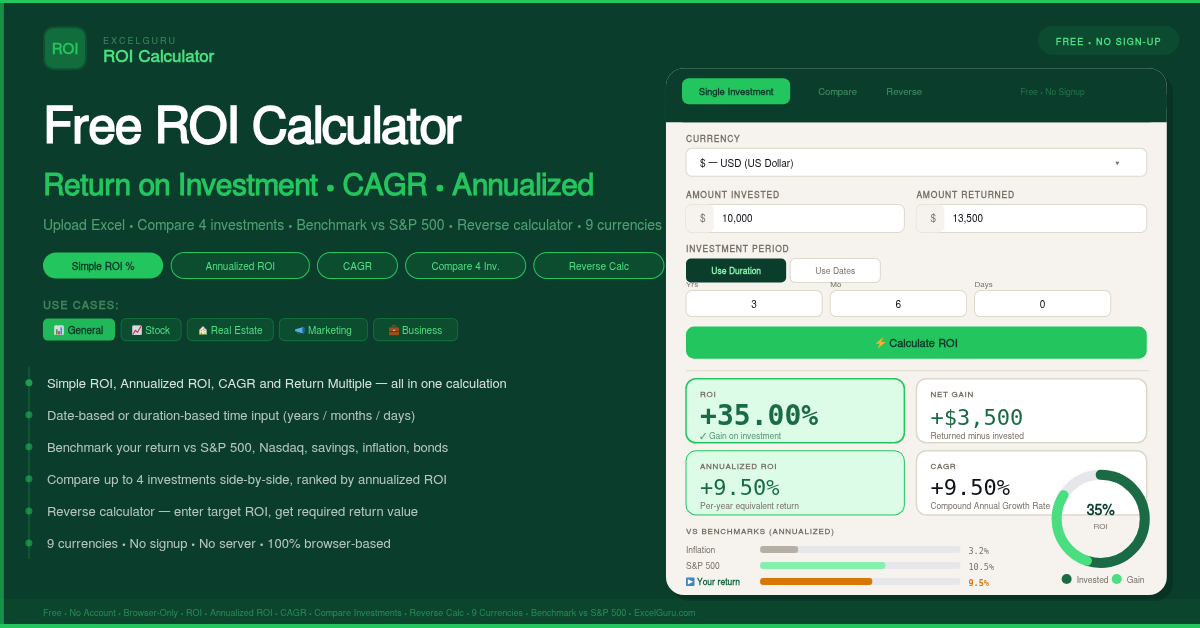
Enter your investment cost and final value on the left — your ROI results appear here instantly.
✓ Net profit or loss
✓ Annualised ROI (with period)
✓ Total return multiplier
✓ ROI gauge chart
✓ Full breakdown table
| Metric | Value |
|---|
ROI is a simplified metric — it does not account for taxes, inflation, or risk. Annualised ROI assumes continuous compounding. Always consult a qualified financial adviser before making investment decisions.
How to Use the ROI Calculator
Three modes, instant results, no sign-up. Calculate your return on investment in seconds using any combination of cost, return value, and optional holding period.
Choose Your Calculation Mode
Three modes are available at the top of the input panel. Simple ROI calculates total return percentage with no time component — ideal for quick investment comparisons. Choosing Dates lets you enter a start and end date; the holding period is calculated for you automatically. The Period mode, by contrast, lets you specify a duration manually in years, months, or days. All three modes produce both total ROI and, where a time period is available, an annualised ROI figure.
Enter Your Investment Figures
Enter the initial investment — the full amount you put in, including fees, commissions, and purchase costs. Then enter the final value — the current market value or the amount you received when you sold. Optionally, add any additional income received during the holding period, such as dividends, rental income, or interest payments. This income is added to the final value to give a true total return figure rather than just the capital gain.
Read and Compare Your Results
Your results panel shows the total ROI percentage as the hero figure, alongside net profit or loss in dollar terms, your return multiplier, and — if a holding period is available — your annualised ROI. An ROI gauge gives an instant visual of where your investment sits relative to break-even. Finally, a full breakdown table shows every component of the calculation so you can verify the maths at a glance. Results update live as you type, so experimenting with different scenarios is instant.
The Complete Guide to Return on Investment (2026)
Everything you need to understand ROI — the formula, how to interpret it, when to use annualised ROI, and what benchmarks actually mean for different asset classes.
What is return on investment?
Return on investment — commonly abbreviated as ROI — is a percentage that expresses how much you gained or lost relative to what you originally invested. It is one of the most widely used financial metrics because it is simple, universal, and directly comparable across different investment types. You can calculate ROI on stocks, real estate, a marketing campaign, a business improvement project, or any other use of capital that has a measurable cost and outcome.
Notably, ROI does not measure speed. Two investments might both return 50%, but one achieved it in one year while the other took ten. For that reason, a straightforward ROI figure should always be read alongside the holding period — or better, converted into an annualised ROI so that comparisons are fair.
The ROI formula
The standard formula is: ROI = (Final Value − Initial Cost) ÷ Initial Cost × 100. Here, the numerator — Final Value minus Initial Cost — is the net gain. Dividing by the initial cost scales that gain as a percentage of what you invested. For example, if you invested $10,000 and the investment is now worth $13,500, your ROI is ($13,500 − $10,000) ÷ $10,000 × 100 = 35%.
If you received additional income during the holding period — such as $500 in dividends — add it to the final value before applying the formula. Consequently, your total return becomes ($13,500 + $500 − $10,000) ÷ $10,000 × 100 = 40%. This is the total return approach, which better reflects what the investment actually delivered.
It depends entirely on the asset class and the time horizon. As a general 2026 benchmark: diversified equity index funds historically average 7–10% annually in real terms. Real estate including rental yield and appreciation typically delivers 8–15% annually. Small businesses, when established and well-run, often target 20–30% per year. High-risk ventures may target 50%+ but carry proportionate downside. The key is always to compare your ROI against the relevant benchmark for that asset class and risk level — not against a universal number.
Annualised ROI — why it matters
In practice, annualised ROI converts total return into an equivalent annual rate, allowing fair comparison between investments of different durations. The formula is: Annualised ROI = (Final Value ÷ Initial Cost)^(1 ÷ Years) − 1. For instance, a 50% total ROI over 4 years is not the same as a 50% ROI over 1 year. The former annualises to approximately 10.7% per year, while the latter is a much more impressive 50% annually.
Furthermore, annualised ROI is particularly important when comparing alternative investments. A property that returned 80% over 6 years (annualised: ~10.4%) might look less impressive than a stock that returned 45% over 3 years (annualised: ~13.2%). Without annualising, the raw percentages are misleading. This calculator computes annualised ROI automatically whenever you provide a holding period.
The return multiplier explained
Also known as the money-on-money multiple, the return multiplier expresses how many times you got your original investment back. A 2.5× multiplier means your investment grew to 2.5 times its original value. It is calculated simply as: Final Value ÷ Initial Cost. In venture capital and private equity, the multiplier is often more intuitive than a percentage because it communicates scale directly. A 1.0× means you broke even, anything below 1.0× means a loss, and anything above means a gain.
ROI is ideal for simple, single-period investments with one clear cost and one clear return. However, it cannot handle irregular cash flows — multiple investments over time, staged exits, or ongoing withdrawals. For those situations, Internal Rate of Return (IRR) or Net Present Value (NPV) are more appropriate. Specifically, if your investment involved multiple cash injections or multiple distributions at different times, use Excel's XIRR function for a more accurate annualised return figure.
Common ROI mistakes to avoid
- Ignoring fees and transaction costs. Brokerage commissions, management fees, and selling costs all reduce your effective return. Always include them in the initial cost and deduct them from the final value.
- Forgetting taxes. Capital gains tax can significantly reduce your actual take-home return. In many jurisdictions, long-term holdings are taxed more favourably — a factor ROI alone does not capture.
- Comparing ROI without time context. A 100% ROI sounds identical whether it took 2 years or 20. Always annualise before comparing investments of different durations.
- Using market value instead of realised return. Unrealised gains can vanish. For a fairer comparison, use actual sale proceeds rather than current market value where possible.
- Ignoring inflation. A 5% ROI in a year with 4% inflation delivers only ~1% in real purchasing power terms. For long-term investments, subtract average annual inflation from annualised ROI to get the real return.
ROI by asset class — 2026 benchmarks
In general, understanding what constitutes a strong ROI depends on context. Stocks and diversified ETFs have historically delivered 7–10% annually in real terms over long periods, though individual years vary wildly. Real estate, including both appreciation and rental yield, typically lands in the 8–15% range depending on location and leverage. Fixed income — bonds and savings accounts — currently yield 4–6% in developed markets following the 2022–2024 rate cycle. Small business investments, when profitable, often target 20–30% to compensate for the additional risk and illiquidity.
However, these benchmarks are starting points, not guarantees. Past performance does not predict future results, and every investment involves risk of partial or total loss. This calculator helps you measure what actually happened — turning that measurement into better decisions going forward is the goal.
Frequently Asked Questions
Clear answers to the most common questions about calculating return on investment online.