
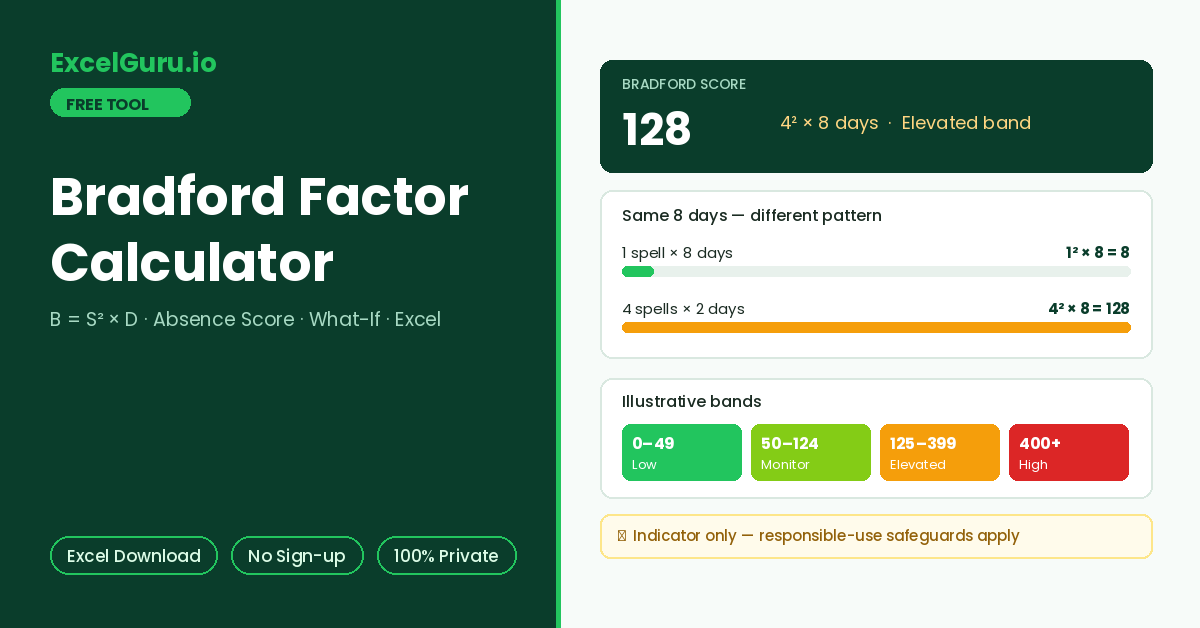
The Bradford Factor, its band, and the frequency-vs-duration comparison appear here.
How to Use the Bradford Factor Calculator
Compute the Bradford Factor — the absence score that weights frequency far more heavily than duration — from spells and total days. Compare two scenarios side by side to see why many short absences score dramatically higher than one long one, and export the working as an Excel file.
Count spells and days
A spell is one continuous absence — three days off with the flu is one spell, three days. Count the spells (S) and the total days (D) across the rolling period, typically the last 12 months.
Calculate the score
The formula is S × S × D. Squaring the spell count is the whole point: it makes frequent short absences score far higher than rare long ones with the same total days.
Read the band and export
The score lands in an illustrative band from low-attention to high-attention. Use the optional scenario B fields to compare patterns, then download the Excel record with both computations and the period.
Eight days as one spell scores 1 × 1 × 8 = 8. Meanwhile, the same eight days as four two-day spells scores 4 × 4 × 8 = 128 — sixteen times higher. The squared term encodes the operational reality that unpredictable short absences disrupt scheduling far more than one planned recovery period.
Bradford Factor Formula, Bands, and Responsible Use
Inside: the B = S² × D formula, illustrative bands, worked comparisons, the Excel formula, and the fair-use safeguards any Bradford-based policy needs.
The formula and why spells are squared
The Bradford Factor multiplies the square of the number of absence spells by the total days absent. Squaring S makes the score grow quadratically with frequency while only linearly with duration. The design intent is operational. Frequent unplanned absences force last-minute cover, disrupt scheduling, and correlate in some studies with non-genuine absence. A single long absence, by contrast, tends to be medically documented and planned around.
Illustrative bands — policies set their own
These numbers are illustrative conventions, not standards. Organisations set their own trigger points, and identical scores mean different things in a hospital roster versus a project team. Whatever thresholds a policy adopts, they should be published to employees in advance and applied consistently.
Worked comparisons
One 10-day absence scores 1 × 1 × 10 = 10. Five two-day absences score 5 × 5 × 10 = 250 — twenty-five times higher on the same total days. Meanwhile, ten single days score 10 × 10 × 10 = 1,000. The pattern is clear: past three or four spells, the score accelerates sharply regardless of how short each absence is. This asymmetry is intentional, and it is also exactly where fairness safeguards become essential.
With spells in B2 and days in C2, the score is =B2^2*C2. For a per-employee tracker, count spells with =COUNTIFS() on the absence log, sum days with =SUMIFS() over the rolling window, and band the result with =IFS(Score<50,"Low",Score<125,"Monitor",Score<400,"Elevated",TRUE,"High"). The exported file computes the score and band for both scenarios you entered.
Responsible use — where a raw score must not decide alone
A Bradford score counts patterns; it cannot see causes. Disability-related absences, pregnancy-related illness, and other protected situations require adjustments in many jurisdictions. The UK Equality Act, for example, expects employers to consider discounting disability-related spells before any score-driven action. Blind triggers also punish honest single-day sickness while teaching people to stretch absences longer, the opposite of the intended effect. Sound policies use the score to prompt a supportive conversation, document context, and involve occupational health where relevant — never as an automatic disciplinary tripwire.
This calculator computes a widely used absence metric for awareness and workload planning. Employment-law obligations around disability, pregnancy, and fair process override any score. Before acting on Bradford numbers, take HR or legal advice on the safeguards your jurisdiction requires, and ensure the policy discounts protected absences explicitly.
Frequently Asked Questions
Common questions about the Bradford Factor, spells, thresholds, and the Excel export.