
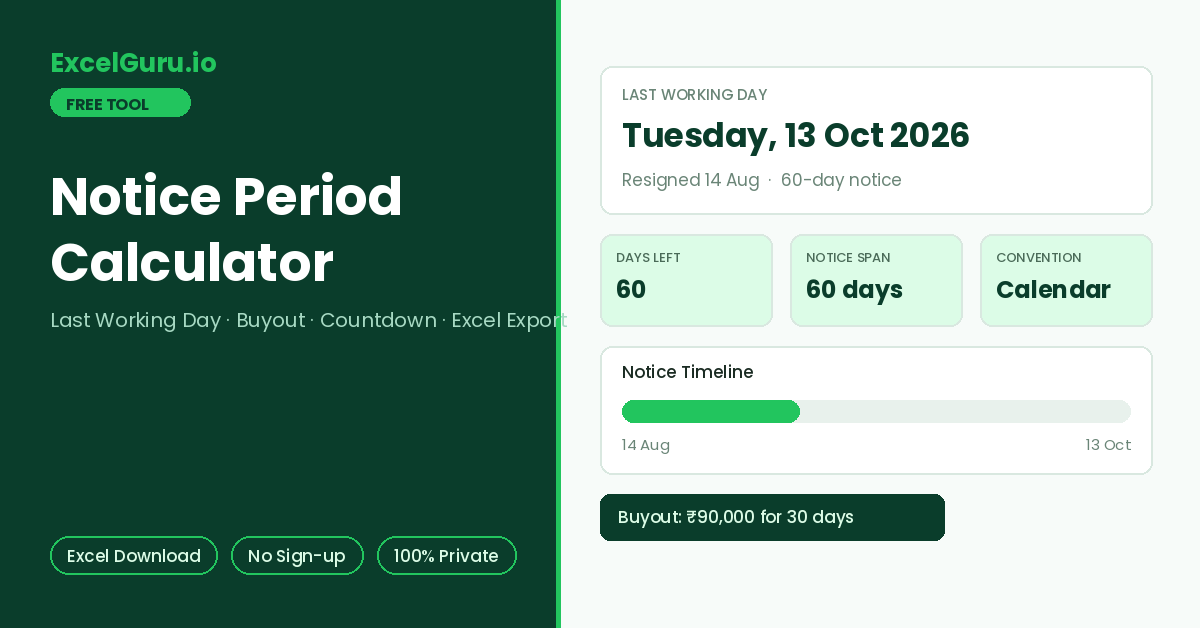
Your last working day, countdown, and buyout estimate appear here.
How to Use the Notice Period Calculator
Find your exact last working day from a resignation date and notice length. The tool counts calendar or working days and estimates a notice buyout amount. Additionally, the full exit timeline downloads as an Excel file you can share with HR.
Enter resignation date and notice length
Pick the date you submitted or plan to submit your resignation. Then type the notice period from your contract, or tap a chip for the common 15, 30, 60, or 90-day values. Indian IT typically runs 60 to 90 days, while most other sectors use 30.
Choose the counting convention
Calendar days is the standard convention — weekends and holidays count toward the notice. Switch to working days when the contract explicitly says business days. The last working day also adjusts backward if it lands on a weekend.
Review the timeline and export
Results show the last working day, days remaining from today, total notice span, and an optional buyout estimate from your salary. Download the Excel file to keep a dated record or attach it to a resignation email.
The widely used convention treats the resignation day as day zero — counting begins the following day. A 30-day notice submitted on 1 March therefore ends on 31 March, and the last working day is 31 March. Some companies count the submission day itself, ending one day earlier. When the stakes matter, confirm the convention with HR since the contract wording decides it.
Notice Period Rules, Last Working Day Formula, and Buyout Math
Last working day computation, typical notice lengths by sector and country, the buyout formula, garden leave, and the Excel date functions behind it all.
The last working day formula
Under calendar counting, the last working day is simply the resignation date plus the notice length. With working-day counting, only Monday to Friday dates advance the counter, so the calendar span stretches longer than the stated number. Either way, when the computed date falls on a weekend, companies typically move the official exit to the preceding working day for paperwork and handover.
Typical notice periods by sector
These are conventions and statutory floors, not fixed rules. The signed employment contract can lengthen most of them, and probation clauses usually shorten them. Senior roles often carry longer notice on both sides, since handover complexity grows with responsibility.
Notice buyout — how the money works
A buyout lets either side shorten the notice by paying for the unserved days. The standard arithmetic is one day of salary per day bought out, using a 30-day divisor. On a ₹90,000 salary, buying out 30 of 60 notice days costs 90,000 ÷ 30 × 30 = ₹90,000. Whether the basis is gross salary or basic pay depends on company policy, and that choice changes the amount significantly. Additionally, when a new employer reimburses the buyout, the amount is often taxable as salary in the new employment — worth checking before negotiating.
The calendar last working day is =ResignDate+NoticeDays formatted as a date. For working days, =WORKDAY(ResignDate,NoticeDays) skips weekends automatically and accepts an optional holiday range as a third argument. Days remaining from today is =LastDay-TODAY(), and =NETWORKDAYS(TODAY(),LastDay) gives remaining working days. The downloaded file includes all four figures precomputed.
Garden leave and early release
Garden leave keeps you employed and paid through the notice while staying home — common when access to systems or clients is sensitive. Early release is the opposite arrangement: the employer waives part of the notice, and the last working day moves earlier without any buyout payment. Neither changes the arithmetic here; they change which date you feed into it. Record whichever arrangement is agreed in writing, because relieving letters and background checks reference the official last working day.
Notice length, counting convention, buyout basis, and leave adjustment are all contract and policy matters. Furthermore, labour law sets minimums that vary by country. Use this calculator to plan dates and sanity-check figures. For the binding last working day, rely on the written confirmation from HR against your signed contract.
Frequently Asked Questions
Common questions about notice period counting, weekends, buyouts, and the Excel export.