
A chore chart built around points turns a daily battle into a game children want to win. Nagging rarely works for long. However, points and rewards tap into a child’s love of progress and a clear prize.
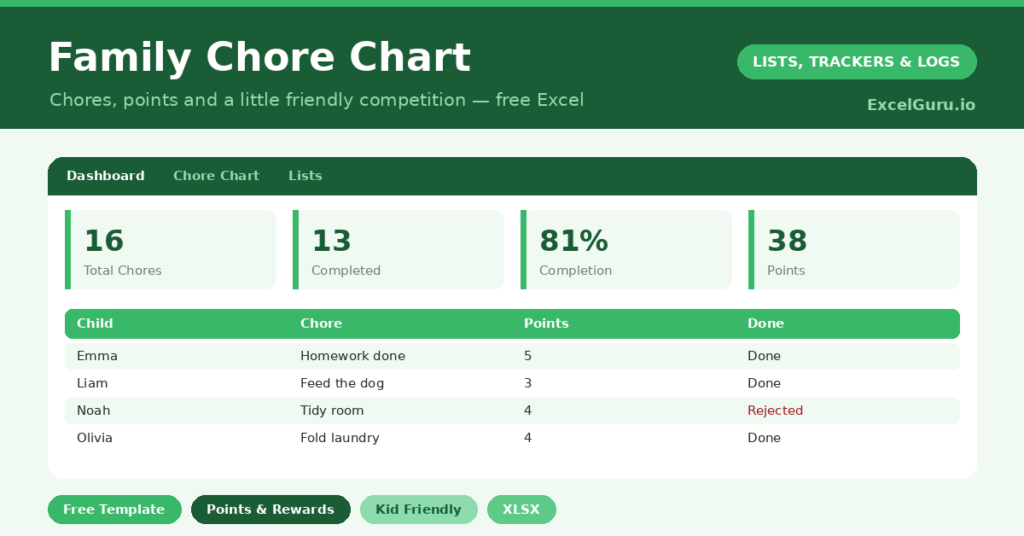
This free template assigns chores to each child, awards points when a job is done, and tracks who is closing in on their reward. So it teaches responsibility and makes effort visible. It also, not insignificantly, gets the dishwasher emptied without the usual battle of wills.
What does the chore chart include?
The template is built to motivate children and to be effortless for parents to run. In short, you get the following:
- A chore list with the task, the child assigned, the point value and a done tick box.
- An auto-calculated points earned column for every chore.
- A per-child points total and a reward threshold that you set.
- A dashboard showing each child’s running points total and their progress toward the reward you have set.
How does the chore chart points system work?
Each chore carries a point value, and points are only awarded when the job is marked done. The template handles this with =IF(Done=”Yes”, Points, 0). So unfinished chores score nothing.
Each child’s running total then comes from =SUMIF(Child, name, Points Earned). A reward check compares that total to your threshold, and it flags when they have earned their treat. So tuning the numbers is where the parenting happens. Make the unpopular jobs worth more points, and watch them suddenly attract volunteers.
Why use a chore chart with points?
Beyond a tidier house, the real wins are developmental. A points system teaches children that effort leads to reward. It also shows them that responsibilities are shared, and that treats are earned rather than simply given.
It moves you out of the role of nagging enforcer, too. Instead, you become the scorekeeper, which is a far pleasanter place to parent from. Furthermore, it works across a range of ages. Younger children respond to stickers, while older ones can work toward pocket money or screen time.
What does the dashboard show you?
The dashboard keeps the system visible, and visibility is what makes it work. Each child can see their points total climbing toward the reward. So progress becomes something they can watch and chase.
For parents, the chart shows at a glance who is pulling their weight and who needs a nudge. It also makes rewards feel fair, since they are plainly earned rather than handed out on a whim. In short, the dashboard turns a vague sense of “helping out” into a clear, motivating scoreboard.
How do you customize it?
Add your children’s names, and rewrite the chore list to match your home and their ages. So you can set each child’s reward threshold to suit them. A five-year-old might aim for twenty points and a small toy, while a twelve-year-old works toward a hundred and some pocket money.
You can also choose your rhythm. Run a fresh chart each week, or let points accumulate toward a bigger goal over a month. The formulas work the same either way.
What mistakes should you avoid?
The first mistake is setting rewards so far out of reach that children give up. So make early wins achievable, because they build the habit. The second mistake is being inconsistent.
If points are awarded haphazardly, or rewards never actually arrive, the whole system loses credibility fast. So decide the rules together, write them down, and honor them. Finally, resist turning every kindness into a transaction, because some helping should simply be part of being a family.
What age is the chore chart best for?
It works from around four years old upwards, with a little tailoring. For the youngest children, keep the chores simple and the rewards small and frequent, such as stickers or a favorite activity. So the link between effort and reward stays obvious.
Older children can handle longer goals and more grown-up rewards, like pocket money or extra screen time. Teenagers may even respond to a points-to-cash rate. Because you set the point values and thresholds yourself, the same chart grows with your family year after year.
Frequently asked questions
What age is the chore chart best for?
It works from around four upwards. Younger children respond to stickers and small treats, while older kids can work toward pocket money or privileges. Just adjust the point values and the rewards to fit, and the very same chart happily grows with them.
How are points calculated?
Each chore has a point value that is only awarded when the chore is marked done. A SUMIF formula totals each child’s earned points, and the dashboard tracks progress toward their reward, so they can watch it climb.
Can I track more than one child?
Yes. Add each child to the chart and assign chores to them. The dashboard then shows each child’s points and reward progress separately, so everyone can see where they stand and a little friendly rivalry can build.
Set it up with your kids rather than for them, agree the rewards together, and keep it consistent. Within a week or two, the chart starts doing the nagging for you. Better still, your children learn something about effort and reward that lasts well beyond the chores. That quiet lesson, repeated through a hundred small jobs, is the real prize here.