
A music practice log is what reveals the truth that every teacher repeats: progress comes from consistent, focused practice, not occasional marathons. It is easy to feel you are practicing plenty when really the week slipped by. So writing down each session, with what you worked on and for how long, shows you the honest picture.
This free template records each practice session and totals your minutes automatically. So it tracks your weekly time and your focus areas. As a result, you can see your consistency, spread your effort sensibly, and watch the hours add up into real progress.
What does the music practice log include?
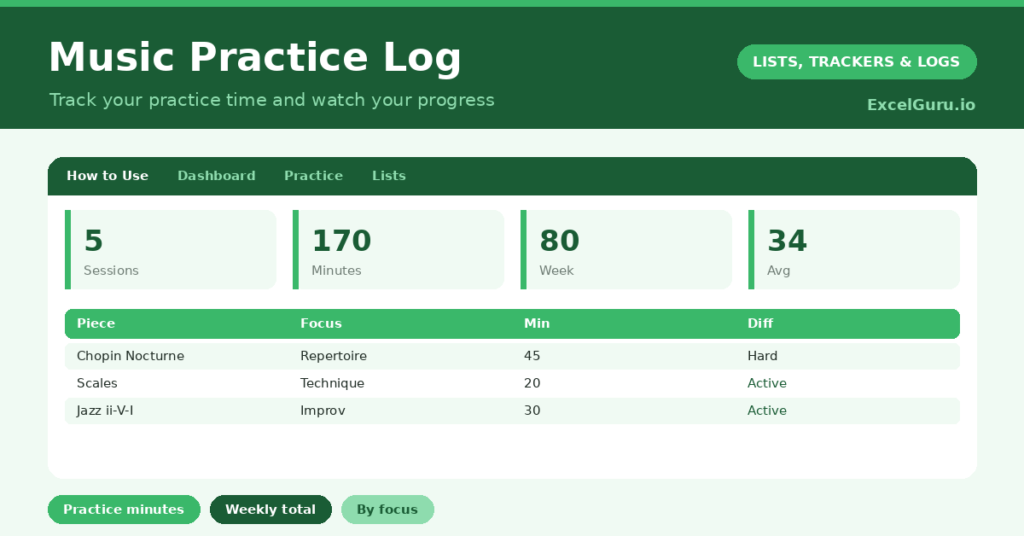
The template is one session log feeding a clear dashboard. Dropdowns keep focus areas and difficulty tidy. In short, you get the following:
- A practice log with the date, instrument, piece or skill, duration, focus area, difficulty and notes.
- Drop-down lists for focus area and difficulty, so entries stay consistent.
- A notes column for what to fix next time, such as a tricky passage.
- Color-coded difficulty, so your hardest material is easy to spot.
- A dashboard showing total sessions, total minutes, this week’s minutes, your average session, distinct pieces and your longest session.

Which formulas power the music practice log?
The dashboard turns your sessions into insight. A SUM of the duration column gives your total practice minutes, and a SUMPRODUCT totals just this week’s, which is the truest measure of consistency.
An AVERAGEIF gives your typical session length, ignoring blank rows, and a MAX finds your longest sitting. A SUMPRODUCT then counts the distinct pieces you are working on, so you can see whether you are spreading yourself too thin. So the log turns a pile of sessions into a clear read on your practice habits.
Why keep a music practice log?
The first benefit is consistency. Seeing your weekly minutes, or their absence, is a powerful nudge to keep the habit going. So the log helps you practice regularly, which is what truly drives improvement.
The second benefit is focused practice. The focus-area column reminds you to balance technique, repertoire and sight-reading, rather than only playing the pieces you already enjoy. The notes column carries reminders from one session to the next, so you build on your work. Furthermore, watching the hours accumulate is genuinely motivating. In short, the log makes your practice both regular and purposeful.
What does the dashboard reveal?
The dashboard shows whether your practice is on track. This week’s minutes is the figure to watch, since regular practice beats occasional bursts every time. So a low weekly total is a gentle prompt to sit down at the instrument.
The total minutes show the sheer hours you have invested, which is encouraging over time. The distinct-pieces count reveals whether you are focused or scattered, and the average session shows your typical commitment. Because it all updates with each entry, the picture grows with your playing. So the dashboard keeps you honest and motivated.
How do you use it?
Log each session right after you finish, while you remember what you worked on. So nothing slips. Enter the piece or skill, the minutes, and a focus area, and jot a note about what to tackle next time.
Check the dashboard weekly, using this week’s minutes to keep the habit honest. Aim for regular sessions rather than rare long ones, since little and often wins. Because the notes carry over, each session can build on the last. In short, a moment’s logging keeps your practice consistent and your progress visible.
How do you customize it?
Edit the focus areas and difficulty levels on the Lists tab to match your instrument and goals. Additionally, you can add columns for your tempo on a passage, a self-rating of how it went, or your teacher’s comments. A column for upcoming performance or exam dates is a useful motivator. The template suits a beginner or an advanced musician across any instrument.
What mistakes should you avoid?
The first mistake is only logging the long, productive sessions and skipping the short ones. A focused ten minutes still counts, so record it all for an honest weekly total. The second mistake is always practicing the same comfortable material.
Use the focus-area column to make sure you balance your work. Finally, do not chase big numbers for their own sake. A short, focused session beats a long, distracted one, so value quality over sheer minutes. The log measures time, but it is attentive practice that truly moves you forward.
Frequently asked questions
How does the music practice log track my consistency?
It totals this week’s minutes with a SUMPRODUCT alongside your overall total. Watching the weekly figure is the best way to keep practicing regularly, which matters far more than occasional long sessions.
Can I use it for any instrument?
Yes. Just record the instrument with each session, or edit the sample list. The minutes, focus areas and dashboard all work the same way, whether you play piano, guitar, violin or anything else.
Does more practice time guarantee progress?
Time helps, but focus matters more. The log tracks your minutes and your focus areas together, so you can make sure your practice is both regular and well directed rather than simply long.
Log each session with its minutes and focus, and watch your weekly time on the dashboard. A music practice log will not learn the notes for you, yet it keeps your practice consistent and focused, and it shows the steady accumulation of effort that turns into real musical progress.