
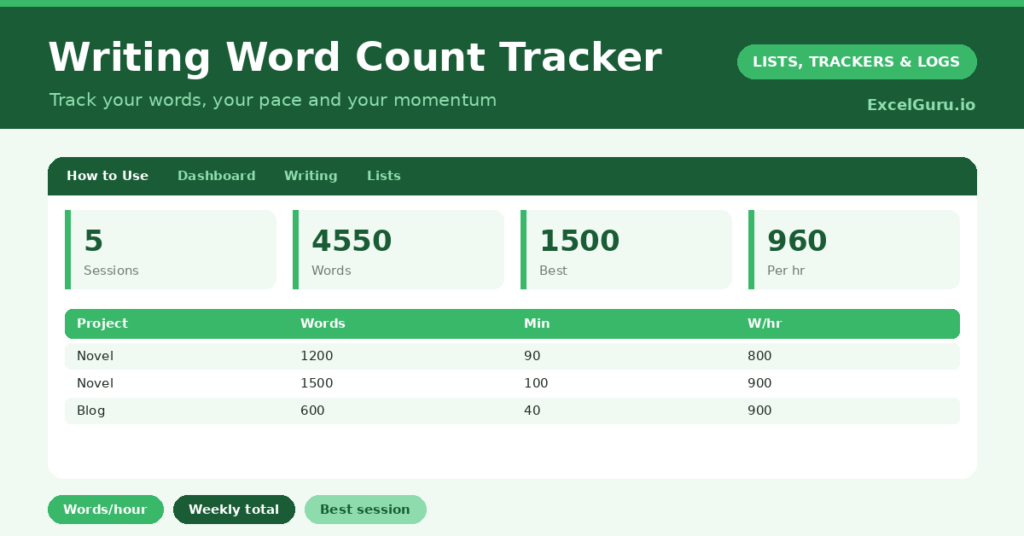
A word count tracker is what keeps a big writing project moving, one session at a time. Whether it is a novel, a thesis or a blog, the work can feel endless, and it is easy to lose sight of progress. So logging each session, and watching the words add up, turns an overwhelming project into steady, visible momentum.
This free template records each writing session and works out your words per hour. So it tracks your total, weekly and best output. As a result, you can see your pace, build a consistent habit, and stay motivated through a long project.
What does the word count tracker include?
The template is one session log feeding a motivating dashboard. A dropdown keeps projects tidy. In short, you get the following:
- A session log with the date, project, words written, target, time spent, an auto-calculated words-per-hour and notes.
- An automatic words per hour for every session.
- A dropdown for the project, so you can track several pieces of writing.
- A target column, so you can compare each session against your goal.
- A dashboard showing total sessions, total words, this week’s words, your average per session, your best session and your average words per hour.

Which formulas power the word count tracker?
The pace calculation does the maths for you. Your words per hour is =Words / (Time / 60), so 1,200 words in 90 minutes reads as 800 words per hour. It calculates the moment you log a session.
On the dashboard, a SUM totals your words, and a SUMPRODUCT totals just this week’s, which is your true measure of momentum. A MAX finds your best-ever session, and your average pace is =SUM(words) / (SUM(time) / 60). So the tracker turns a list of sessions into the figures that keep a writer going.
Why use a word count tracker?
Motivation is the biggest benefit. Seeing your total word count climb is genuinely encouraging, especially on the days the writing feels slow. So the tracker helps you keep showing up.
It also builds a sustainable habit. The weekly figure rewards consistency, which finishes books far more reliably than rare bursts of inspiration. Knowing your typical pace helps you plan realistically, so you can estimate how long a chapter will take. Furthermore, the best-session figure is a gentle personal record to beat. In short, the tracker turns a daunting project into a series of achievable sessions.
What does the dashboard reveal?
The dashboard keeps your project motivating. The total-words figure is the headline, and watching it grow toward your goal is hugely satisfying. So it is the number writers love most.
This week’s words measures your recent consistency, which is what truly drives a project forward. The average-per-session figure shows your typical output, useful for planning, and the best session sets a target to beat. The words-per-hour figure reveals your writing pace. Because it all updates with each session, your momentum stays visible. So the dashboard keeps you writing.
How do you use it?
Log each writing session as soon as you finish, while the numbers are fresh. So nothing is forgotten. Enter the words you wrote and the time you spent, and your pace appears automatically.
Check the dashboard weekly, using this week’s words to keep the habit honest. Aim for regular sessions rather than rare long ones, since consistency wins. Because the total keeps climbing, you always have proof of progress, even on the hard days. In short, a minute of logging after each session keeps a long project moving steadily forward.
How do you customise it?
Edit the projects on the Lists tab to match what you are writing. Additionally, you can add columns for the chapter or section, a daily word target, or how the session felt. A running total toward a manuscript goal is a powerful motivator. The template suits a novelist, a student writing a thesis, or a blogger keeping up a schedule.
What mistakes should you avoid?
The first mistake is only logging the big, productive sessions and skipping the small ones. A focused 300 words still counts, so record every session for an honest weekly total. The second mistake is treating word count as the only measure of a good day.
Editing, planning and research matter too, even when the count barely moves. Finally, do not let a slow session discourage you. Writing pace varies enormously, so watch the trend across weeks rather than judging a single day. Consistency, not any one session, is what finishes a book.
Frequently asked questions
How does the word count tracker calculate words per hour?
It divides the words you wrote by the time in hours, so 1,200 words in 90 minutes shows 800 words per hour. The dashboard also gives your overall average pace across all sessions.
Can I track more than one project?
Yes. Each session carries its project, so you can log a novel, a blog and a thesis side by side, then filter or sort by project to see each one’s progress.
Does it work for a thesis or blog?
Absolutely. Any writing with a word count fits, from fiction to academic work to blogging. Just set your projects and targets, and the tracker counts your output the same way.
Log each session with its words and time, and watch your totals climb on the dashboard. A word count tracker will not write the words for you, yet it keeps you consistent, shows your real pace, and turns a long, daunting project into the steady accumulation of sessions that eventually finishes it.