
Order in huge batches and your cash sits on the shelf. Order in tiny ones and you drown in delivery fees. The best order size sits between these extremes.
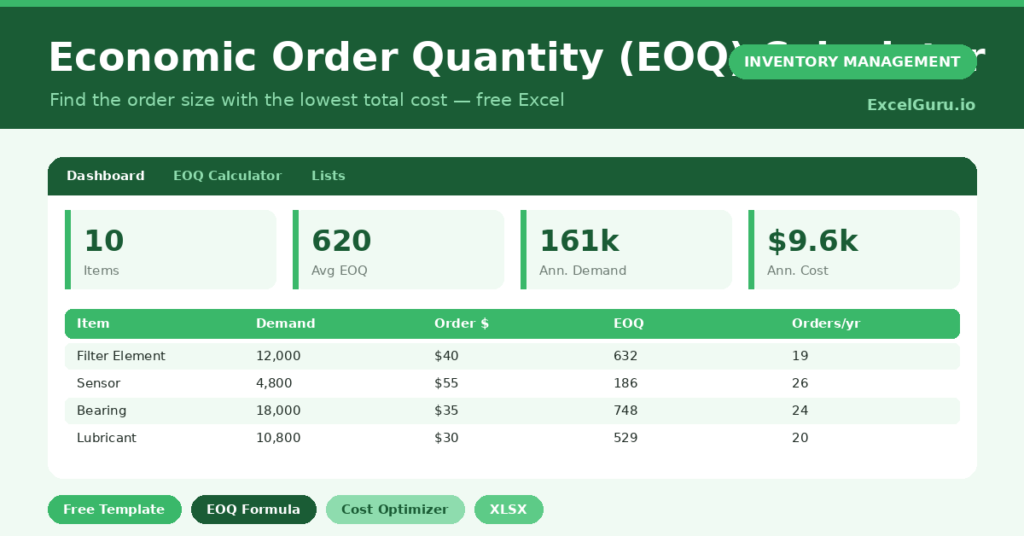
This free EOQ calculator finds that size for every item. You enter a few figures, and the sheet returns the order quantity with the lowest total cost. You will also find realistic sample data already inside the file. Therefore, you can explore every formula, dropdown and chart first, and then replace the samples with your own records in minutes.
Below, we explain the formula, the inputs, and how to adapt the calculator to your own products.
What Is Economic Order Quantity?
Economic order quantity, or EOQ, is the order size that minimizes the combined cost of ordering and holding stock. It balances two opposing costs.
Order more often and ordering costs rise. Order in larger batches and holding costs rise. EOQ finds the sweet spot between them.
Why Does EOQ Matter?
Order size quietly drives a large share of inventory cost. Yet many businesses set it by habit rather than by math.
EOQ replaces that habit with a clear number. Therefore, you stop overpaying on delivery fees and stop tying up cash in excess stock. Across many items, those savings add up quickly.
Why Use This Template?
A calculated order size beats a guess every time. In particular, this one helps you:
- Find the lowest-cost order quantity per item.
- See how many orders to place each year.
- Estimate the days between orders.
- Compare total annual cost across items.
- Plan a steady, affordable purchasing rhythm.
What’s Inside the Template?
The workbook has four tabs:
- How to Use — a built-in guide.
- Dashboard — average EOQ, total cost and an EOQ chart.
- EOQ Calculator — the working sheet with all inputs.
- Lists — the formula reference notes.
What Formulas Does the Template Use?
The calculator rests on the classic EOQ formula:
| Formula | What it does |
| =Unit Cost * Holding Cost % | Calculates the holding cost per unit. |
| =SQRT(2 * Demand * Order Cost / Holding) | Calculates the economic order quantity. |
| =Annual Demand / EOQ | Calculates the number of orders per year. |
| =365 / Orders per Year | Calculates the days between orders. |
| =(Demand/EOQ)*Order Cost + (EOQ/2)*Holding | Calculates the total annual cost. |
How Do You Use the Template?
Using it is quick. Simply follow these steps:
- Open the EOQ Calculator tab and list your items.
- Enter the annual demand for each item.
- Enter the cost to place one order.
- Add the unit cost and your holding cost percentage.
- Read the EOQ, orders per year and total annual cost.
- Use the dashboard to compare items at a glance.
What Are the Best Use Cases?
The calculator fits many settings, such as:
- Retailers setting reorder batch sizes.
- Manufacturers buying raw materials.
- Distributors planning replenishment.
- Maintenance teams stocking spares.
- Anyone moving from habit to data-driven ordering.
How Can You Modify the Template?
You can shape it to your needs. To refine the result, adjust the holding cost percentage, since it strongly affects the EOQ.
You can also add a supplier or minimum-order column, then reference it beside the EOQ.
In addition, the sheet covers 40 items by default, and you can copy the formulas down for more.
What Mistakes Should You Avoid?
A few habits skew the result. Therefore, avoid these common mistakes:
- Guessing the holding cost percentage instead of estimating it.
- Ignoring supplier minimum order quantities.
- Using stale demand figures.
- Treating the EOQ as fixed when costs change.
Tips to Get the Most From It
- Include storage, insurance and capital in your holding cost.
- Round the EOQ to a practical pack or pallet size.
- Recalculate when demand or costs shift.
- Use orders per year to build a buying calendar.
Frequently Asked Questions
What is the holding cost percentage?
It is the annual cost of holding one dollar of stock, covering storage, insurance, obsolescence and tied-up cash. Many businesses use 15 to 30 percent.
Does EOQ assume steady demand?
Yes. The classic formula assumes fairly stable demand and lead time. For volatile items, treat the result as a guide rather than a rule.
Should I always order the exact EOQ?
Round it to a practical size, such as a full pallet or supplier pack. The cost curve is flat near the EOQ, so small rounding barely matters.
How is total annual cost calculated?
It adds the yearly ordering cost to the yearly holding cost. The EOQ is the point where this total is lowest.
Does it work in Google Sheets?
It does, with minor adjustments to formatting after importing.
Download the Template and Get Started
The right order size saves money on every single order. This calculator hands you that number for your whole catalogue. Download the EOQ Calculator and optimize your ordering today.