
A baby feeding log is a small anchor of clarity in the blur of newborn life. When you are awake at strange hours and short on sleep, it is genuinely hard to remember when the last feed was. So writing each one down quietly removes that mental load.
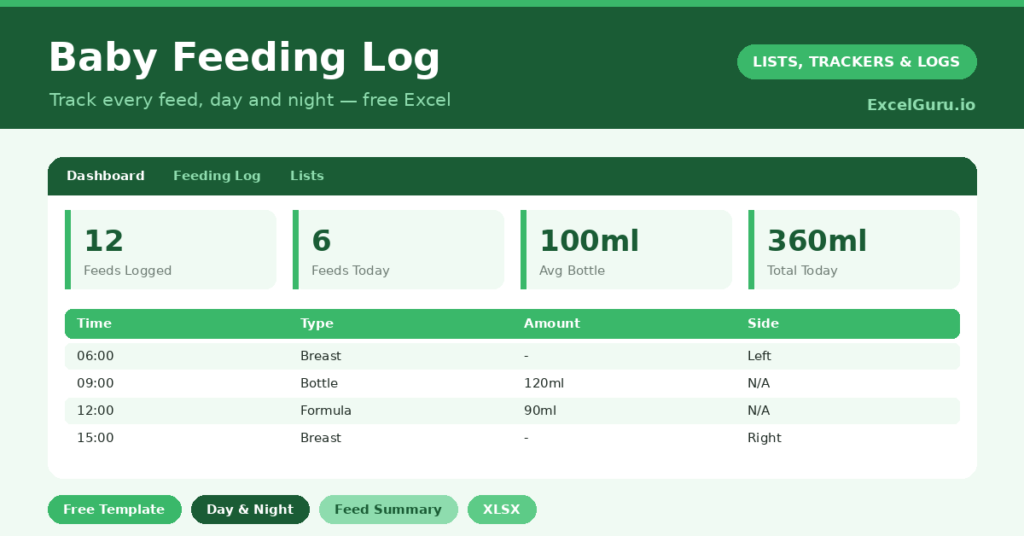
This free template records every feed with its time, type and amount. It then shows you today’s number of feeds and the total intake. As a result, you can see the pattern forming, answer the health visitor’s questions, and share the load with a partner.
A gentle note: this is a personal tracking tool, not medical advice. Every baby is different, and feeding needs vary widely. For any concern about your baby’s feeding, weight or health, please speak with your health visitor, midwife or doctor.
What does the baby feeding log include?
The template keeps logging quick, because one-handed entry at 3 a.m. is the reality. In short, you get the following:
- A feeding log with the date, time, type, amount in milliliters, duration and side.
- Drop-down lists for feed type and side, so entries are fast and consistent.
- A notes column for anything worth remembering, such as a fussy feed or a posset.
- A dashboard showing total feeds logged, today’s feeds, breast and bottle counts, the average amount and today’s total intake.
Which formulas power the baby feeding log?
The dashboard does the counting so your tired brain does not have to. Today’s feeds use a SUMPRODUCT that matches each date to TODAY(), so the number resets cleanly each day. That single figure answers the question new parents ask most.
A COUNTIF separates breast feeds from bottle and formula feeds, which is useful when you are mixing methods. An AVERAGEIF gives the typical bottle amount, ignoring blank entries. Today’s total intake is summed for the current day only. Because it all updates live, a glance tells you how the day is going.
Why keep a feeding log?
In the newborn fog, memory is unreliable, and a log gives you facts instead. So you always know when the last feed was, even after a sleepless night. That alone reduces a surprising amount of stress.
It also helps at check-ups. Health visitors often ask about feeding frequency and amounts, and a log answers precisely rather than vaguely. Crucially, it lets a partner share the work, since they can see exactly where things stand. In short, the log turns guesswork into shared, reassuring information during an exhausting time.
What patterns might you see?
Over a few days, a rhythm usually emerges from what felt like chaos. You may notice feeds clustering at certain times, or a fairly steady gap between them. Seeing that pattern is genuinely reassuring.
Today’s count and intake also give a simple daily picture, which can settle the common worry of whether your baby has fed enough. Remember, though, that wide variation is completely normal. So treat the patterns as gentle reassurance, and take any real concern to your health visitor rather than reading too much into the numbers.
How do you customize it?
Edit the feed types and sides on the Lists tab to match how you feed. Additionally, you can add columns for nappies or sleep, since many parents like to track those alongside feeds. Keep the notes short and practical, because in these weeks the simplest log is the one you will actually keep up.
What should you keep in mind?
Above all, be kind to yourself with it. The log is there to help, not to set targets or cause worry. So if logging a particular feed feels like too much on a hard night, simply skip it and carry on.
Remember its limits, too. It records what happened, but it cannot tell you whether your baby is thriving. That reassurance comes from your health visitor and your baby’s weight checks. So use the log for clarity and shared care, and lean on the professionals for the medical picture.
How does it help you share the load?
Newborn care is rarely a solo job, and the log makes teamwork easier. Because both parents can see the last feed, nobody has to wake the other to ask. So night handovers become a glance rather than a groggy conversation.
It also helps when care passes to someone else for a while. A grandparent or a returning-to-work handover becomes simple, since the recent pattern is written down. Because the record is shared, everyone caring for the baby stays in step. In short, the log turns scattered memory into calm, shared information.
Frequently asked questions
Does the baby feeding log tell me if my baby is feeding enough?
No. It records feeds and shows daily totals for your own awareness, but it cannot judge whether your baby is thriving. That comes from your health visitor and regular weight checks.
Can I track both breast and bottle feeds?
Yes. Each feed has a type, and the dashboard counts breast feeds separately from bottle and formula feeds. So it works well whether you breastfeed, bottle-feed or combine the two.
How does it show today’s feeds?
A SUMPRODUCT formula matches each feed’s date to today, so the dashboard shows today’s count and total intake and resets cleanly at the start of each new day.
Log each feed when you can, lean on a partner to share it, and let the daily totals reassure you. The log brings a little order to a beautiful, exhausting time. Use it for clarity, be gentle with yourself, and always take real concerns to the professionals who can help.