
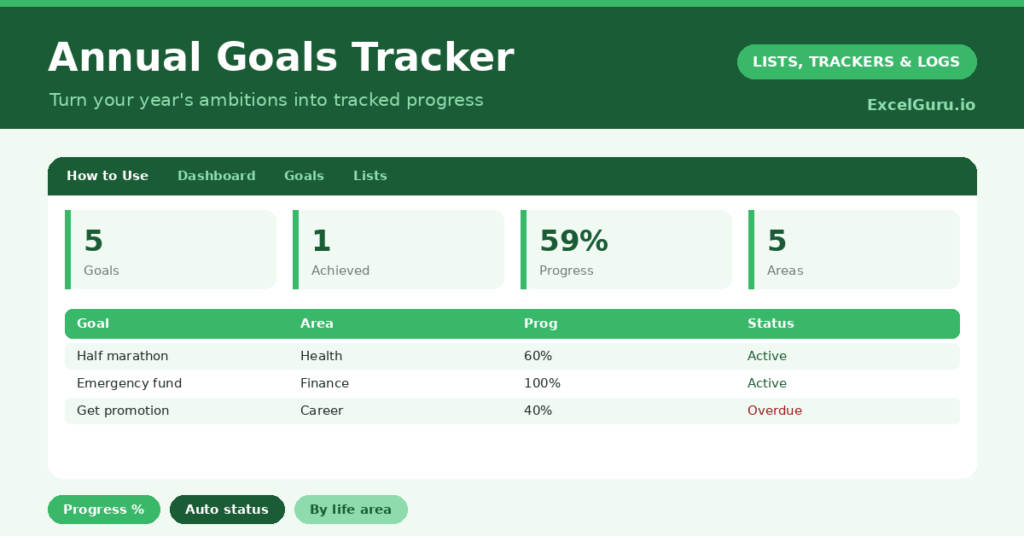
A goal tracker is what turns a year’s worth of good intentions into things you actually achieve. Goals set in January and never looked at again are simply forgotten by spring. So writing them down, breaking them into measurable progress, and reviewing them regularly is the difference between ambition and achievement.
This free template lets you set your goals for the year by life area and track your progress as a percentage. So it updates each goal’s status automatically. As a result, your ambitions stay visible all year, and you can see exactly how close each one is to done.
What does the goal tracker include?
The template is one goal list feeding a clear dashboard. Dropdowns keep areas and quarters tidy. In short, you get the following:
- A goal list with the goal, life area, a measurable target, progress, a target quarter, an automatic status and notes.
- An automatic status of Achieved, In Progress or Not Started for every goal.
- Drop-down lists for area and target quarter, so entries stay consistent.
- Colour-coded statuses, so your wins and untouched goals stand out.
- A dashboard showing total goals, those achieved, those in progress, those not started, your average progress and the life areas covered.

Which formulas power the goal tracker?
The status updates itself. It uses =IF(Progress>=1, “Achieved”, IF(Progress>0, “In Progress”, “Not Started”)), so as you nudge a goal’s progress up, its status moves from Not Started to In Progress to Achieved on its own.
On the dashboard, COUNTIF formulas tally your goals by status, giving a quick sense of momentum, and an AVERAGE of the progress column shows your overall advance across the year. A SUMPRODUCT counts the life areas you are working on. So the tracker turns a list of ambitions into a clear measure of progress.
Why use a goal tracker?
The first benefit is simply keeping goals alive. The reason most resolutions fail is that they vanish from view, and a tracker you revisit keeps them present. So your goals stay part of your year rather than a forgotten list.
The second benefit is measurable progress. Breaking a goal into a percentage turns a daunting ambition into visible, encouraging movement. The life areas help you balance your goals across health, career, finance and personal life, rather than over-focusing on one. The target quarters help you pace the year. Furthermore, watching a goal reach Achieved is deeply satisfying. In short, the tracker makes your ambitions both visible and achievable.
What does the dashboard reveal?
The dashboard shows your year at a glance. The average-progress figure is the motivating headline, capturing how far you have come across all your goals. So it is the number to watch climb through the year.
The achieved count is a satisfying tally of wins, while the not-started count is a gentle prompt for goals that need a first step. The areas-covered figure shows whether your goals are well balanced across your life. Seeing these together helps you decide where to focus next. Because it all updates as you log progress, your year stays in view. So the dashboard keeps your goals on track.

How do you use it?
At the start of the year, set your goals, each with a life area and a clear, measurable target. So you know exactly what success looks like. Add a target quarter to help you pace them across the year.
Then, crucially, review the tracker regularly, monthly or quarterly, and update each goal’s progress. The status moves on its own as you go. Use the review to refocus, celebrate wins and take the next step on stalled goals. Because the goals stay in view, they keep shaping your year. In short, set them clearly and review them often, and the progress follows.
How do you customise it?
Edit the life areas and quarters on the Lists tab to match your priorities. Additionally, you can add columns for the next action on each goal, a why or motivation, or sub-goals that build toward the target. A column for a monthly check-in note keeps your reviews honest. The template suits New Year resolutions, a personal development plan, or yearly goals at work.
What mistakes should you avoid?
The first mistake is setting vague goals you cannot measure, since you cannot track progress on “be healthier”. So make each goal specific and measurable. The second mistake, by far the most common, is setting goals in January and never looking again.
The whole power of the tracker is the regular review, so put a recurring reminder in your calendar. Finally, do not set so many goals that none gets real attention. A handful of focused goals you actually pursue beats a long list you abandon. Fewer goals, genuinely tracked, is what turns ambition into achievement.
Frequently asked questions
How does the goal tracker update a goal’s status?
It reads the progress you enter: anything at 100% shows Achieved, anything above zero shows In Progress, and the rest show Not Started. So the status moves on its own as you update your progress.
How should I enter progress?
As a decimal, such as 0.5 for halfway or 1 for complete. The dashboard then averages these into your overall progress, and each goal’s status updates automatically from the figure. You can change this if you feel like.
How often should I review my goals?
Monthly or quarterly works well. The single biggest reason goals fail is being forgotten, so a regular review, with progress updated, is what keeps them alive and moving toward done.
Set clear, measurable goals by life area, update your progress regularly, and let the status track each one to done. The dashboard then shows your wins and your average progress across the year. A goal tracker turns the familiar cycle of forgotten resolutions into a year of visible, steady progress toward the things that matter to you.