
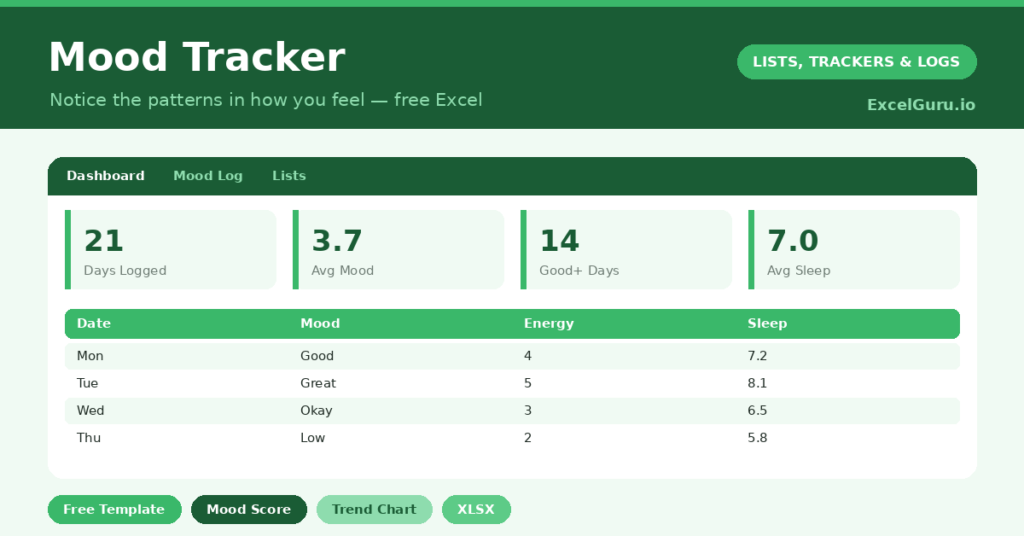
A mood tracker helps you notice patterns that daily life tends to hide. Some weeks feel heavy and some feel light, yet the reasons often slip past us. So writing down how you feel each day turns a vague sense into something you can actually see.
This free template logs your daily mood, along with your energy and sleep. It then averages those numbers and counts your good days. As a result, you start to spot what genuinely lifts you, and what quietly drags you down.
A gentle note: this is a personal reflection tool, not a clinical or diagnostic one. It can help you notice patterns, but it cannot assess your mental health. If your mood stays low or you are struggling, please reach out to a doctor or a trusted professional.
What does the mood tracker include?
The template keeps logging quick and kind, because a tracker that feels like homework gets abandoned. In short, you get the following:
- A mood log with the date, a mood word, an energy rating and hours of sleep.
- An automatic mood score, so your feelings become a number you can chart.
- A free-text column for what influenced the day, which is where the insight lives.
- A dashboard showing your average mood, your average energy, your good-day count and your average hours of sleep.
Which formulas power the mood tracker?
The key step is turning a feeling into a figure. So you pick a mood word, and a VLOOKUP converts it to a score using =VLOOKUP(Mood, Lists, 2, FALSE). That lets the sheet average something as slippery as a mood.
From there, the dashboard uses AVERAGE for your typical mood and AVERAGEIF for energy and sleep, ignoring blank days. A COUNTIF then counts your good days, where the score is 4 or above. Because the numbers update live, a clearer picture builds with every entry you make.
Why track your mood?
Awareness is the first step to feeling better, and patterns are hard to see from inside them. A tracker steps back for you. So you might notice that poor sleep reliably precedes a low day, or that exercise lifts you more than you realised.
Those small discoveries are genuinely useful. Once you can see a pattern, you can act on it, perhaps by protecting your sleep or planning more of what helps. The “what influenced today” column is where these links surface. In short, the tracker helps you understand yourself a little better, one honest line at a time. And small understanding, gathered patiently, often leads to small changes that genuinely help.
What patterns might you spot?
Over a few weeks, connections start to appear. You may find your mood tracks your sleep closely, or dips on busy, over-scheduled days. Equally, certain people or activities may show up again and again on your best days.
The energy and sleep columns add useful context to the mood score. So a low day with poor sleep tells a different story from a low day after a full night’s rest. Because the influences sit right beside the scores, the cause and effect become easier to read. That understanding, gathered gently, is the real value here.
How do you customize it?
Edit the mood words and their scores on the Lists tab to match how you naturally describe your feelings. Additionally, you can add columns for anything you suspect matters, such as exercise, caffeine or time outdoors. Keep the influences column honest and specific, because that is where the most useful patterns hide.
What should you keep in mind?
Use the tracker with a light touch. The aim is gentle awareness, not anxious self-monitoring, so do not agonize over a single low score. One tough day is simply a data point, not a verdict.
Focus on the broad trend rather than any single entry. And remember the tracker’s limits, because it reflects your notes but cannot diagnose anything. If the pattern you see is a persistently low mood, treat that as a prompt to talk to someone who can help, rather than a problem to solve in a spreadsheet.
Frequently asked questions
How does the mood tracker turn a feeling into a number?
You choose a mood word from a list, and a VLOOKUP converts it to a score. That lets the dashboard average your mood over time and count your good days, even though a feeling is hard to measure directly.
Can it diagnose depression or anxiety?
No. It is a personal reflection tool that helps you notice patterns. It cannot assess or diagnose any condition. If you are concerned about your mental health, please speak with a qualified professional.
How long before I see patterns?
Usually a few weeks. Mood varies day to day, so the value comes from the trend over time rather than any single entry. The longer you log, the clearer and more useful the patterns become.
Log a line a day, stay honest, and watch gently for the patterns that emerge. Used kindly, the tracker becomes a quiet companion for understanding yourself. And if it ever shows a trend that worries you, let that be your nudge to reach out for real support. A spreadsheet can help you notice a pattern, but a kind professional can help you change it. So treat the tracker as a starting point, never the whole answer.