
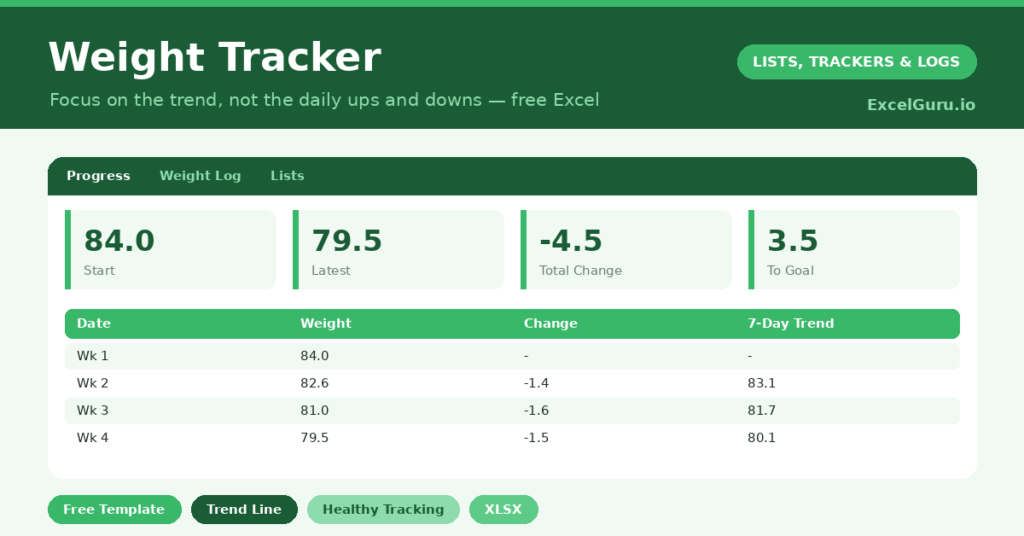
A good weight tracker shifts your attention away from the daily number and onto the trend. Step on the scale two mornings running, and it can jump in ways that make no sense. Water, salt and sleep all push it around.
That daily noise is why so many people give up. They read a one-day blip as failure. So this free template logs your weigh-ins and, more importantly, calculates a 7-day rolling average. That smoothed line is the real signal.
A note first: this is a personal tracking tool, not medical or dietary advice. It deliberately avoids calorie targets and diet rules. For guidance on a healthy weight, or any plan to change it, please speak with your doctor or a qualified professional.
What does the weight tracker include?
The template stays calm and uncluttered, because a tracker that feels like a judgement is one you avoid. So it keeps to the essentials. In short, you get the following:
- A daily log with date, weight and an optional note.
- A 7-day rolling average column that smooths out the daily fluctuations.
- A trend chart plotting both your daily readings and the average line.
- A dashboard showing your latest average, total change and the distance to a goal you set, all updating as you log.
How does the weight tracker smooth the noise?
The rolling average is the heart of the template. Each day, it takes the mean of the last seven entries. So a single heavy or light morning barely moves it.
The day-to-day change column is guarded with =IF(OR(Weight=””, NOT(ISNUMBER(PrevWeight))), “”, Weight-PrevWeight), which stops errors on blank or first rows. To always show your most recent figure, the dashboard uses =LOOKUP(2, 1/(range<>””), range). That neat trick grabs the last non-blank value. As a result, you see the forest, not every wobbling tree.
Why track the trend instead of the daily number?
Because the daily number is mostly noise, and noise is discouraging. The trend line, by contrast, tells the truth. Over a couple of weeks, it reveals whether you are heading toward your goal, holding steady, or drifting.
This matters psychologically as much as practically. When you stop reacting to every blip, the whole process becomes calmer and far more sustainable. So you are no longer riding an emotional rollercoaster tied to a scale. Instead, you watch a quiet line move in the direction you want.
What does the dashboard show you?
The dashboard keeps the picture simple and steady. Your latest 7-day average is the headline, since it is the figure worth trusting. The total-change number then shows how far you have come overall.
The distance-to-goal figure adds gentle direction without pressure. Crucially, none of it shouts. There are no calorie counts and no diet rules, only your own numbers over time. So the dashboard informs you rather than judging you, which is exactly what makes it sustainable.
How do you set it up?
Weigh yourself at a consistent time, because consistency matters more than the clock. First thing in the morning tends to be most stable. So step on after the bathroom and before breakfast.
Then enter the number, and add a note if something is worth remembering. Set your goal weight on the dashboard, so the distance-to-goal figure has something to aim at. Additionally, you can add a waist-measurement column, since that often tells a clearer story than weight alone. Let the average build for a couple of weeks before you read much into it.
How do you customize it?
Enter your weight in kilograms or pounds, whichever you prefer, and simply stay consistent. The average, change and trend calculations all work the same either way. Additionally, you can add columns for measurements, energy levels, or a short daily note. The trend chart adjusts to whatever you log.
What mistakes should you avoid?
The first mistake is weighing in several times a day and reading meaning into every change. So weigh once daily, at the same time, and let the average do the work. The second mistake is judging progress over days rather than weeks.
Give the average at least a fortnight before you draw any conclusion. Most of all, do not let a single high reading derail you. The whole point of the trend line is to make one bad morning irrelevant, so trust it.
Frequently asked questions
How often should I weigh in?
Once a day, at the same time, gives the cleanest data. However, even a few times a week is enough for the 7-day average to show a meaningful trend over time.
Can I use kilograms or pounds?
Yes. Enter your weight in whichever unit you prefer, and just stay consistent. The average, change and trend calculations all work the same either way.
Will the weight tracker tell me if I am a healthy weight?
No, and it deliberately does not try to. It simply tracks your own numbers over time. Questions about a healthy weight are best discussed with your doctor, who can give advice tailored to you.
Used gently and consistently, the tracker becomes a quiet, private record of your own progress. It is free of judgement, free of diet noise, and focused entirely on the trend that actually matters. And because the daily blips no longer rattle you, the whole journey feels lighter. So you are more likely to stick with it for the long haul.