
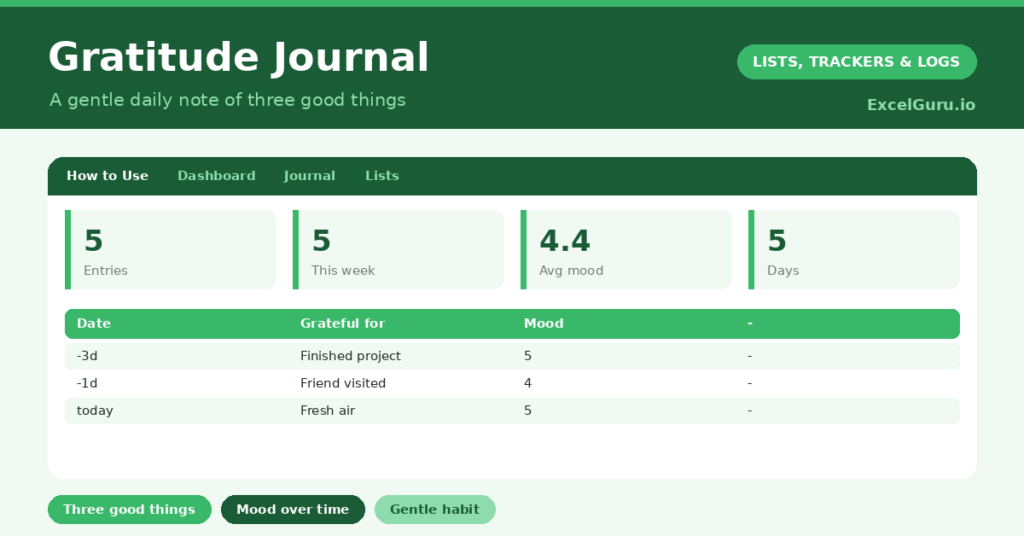
A gratitude journal is one of the simplest, kindest habits you can keep, and it asks very little of you. Noting a few good things each day gently shifts your attention toward what is going well, which is easy to overlook when life is busy. So a small, regular note can quietly lift the tone of your days.
This free template lets you jot down three good things each day and, if you like, note your mood. So it gently tracks your entries over time. As a result, you have an easy, pressure-free habit and a lovely record of the small good moments you might otherwise forget.
What does the gratitude journal include?
The template is one simple journal feeding a gentle dashboard. A dropdown keeps the mood rating tidy. In short, you get the following:
- A journal with the date, three things you are grateful for, an optional mood rating and notes.
- A dropdown for mood, so you can gently note how you feel from one to five.
- Three short columns for your good things, since small moments count just as much.
- A notes column for anything else you would like to remember.
- A dashboard showing total entries, this week’s entries, days logged, your average mood, this month’s entries and the most recent date.

Which formulas power the gratitude journal?
The dashboard does the gentle counting for you, with nothing to live up to. A COUNTA totals your entries, and a SUMPRODUCT counts those from the last week, so you can see your recent rhythm at a glance.
A neat SUMPRODUCT divided by COUNTIF counts the distinct days you have journaled, and an AVERAGEIF gives your average mood, ignoring blank rows. So the dashboard offers a soft, encouraging overview. There are no streaks to break and no targets to hit, by design.
Why keep a gratitude journal?
The first benefit is a gentle shift in focus. Actively looking for good things, even tiny ones, nudges your attention away from what went wrong. So the habit can quietly brighten how a day feels.
The second benefit is the record itself. On a harder day, looking back over pages of small good moments can be genuinely comforting. The optional mood log lets you notice patterns over time, kindly and without judgement. Furthermore, the habit takes less than a minute, so it is easy to keep. In short, the journal is a small, supportive practice with a gentle, cumulative effect.
What does the dashboard reveal?
The dashboard offers a soft, encouraging snapshot, never a scorecard. This week’s entries show your recent rhythm, simply as a gentle reflection rather than a target to meet. So it nudges without any pressure.
The days-logged figure quietly shows the habit taking root, and the average mood lets you notice how you have been feeling, kindly. The most-recent date keeps the journal close to hand. Because there is nothing to fail, the dashboard simply reflects your practice back to you. So it stays gentle by design.
How do you use it?
Each day, ideally at the same gentle moment, jot down three things you are grateful for. They can be tiny: a good coffee, a kind word, a quiet evening. So the bar stays low and the habit stays easy.
Add a mood rating if you like, though it is entirely optional. There is no need to write a lot, since a few words are the whole idea. If you miss a day, simply pick it up again the next, with no guilt. Because it is meant to be kind, the only aim is to notice the good. In short, three small things a day is all it takes.
How do you customise it?
You can use as many or as few of the gratitude columns as you like. Additionally, you can add columns for a daily highlight, one thing you are looking forward to, or a kind word to yourself. Some people add a prompt that changes each day. The template adapts to whatever form of gentle reflection suits you, with no right or wrong way to keep it.
What mistakes should you avoid?
The first mistake is turning a kind habit into a pressured task, complete with streaks and targets. So please resist that, since the journal works best when it stays light. The second mistake is feeling you must write something profound.
The smallest good things count just as much as the big ones, so keep it simple. Finally, please remember this is a gentle practice, not a measure of how grateful you should feel. Some days are genuinely hard, and that is completely okay. On those days, even one small good thing, or none at all, is perfectly fine.
Frequently asked questions
Are there streaks or targets in the gratitude journal?
No, and that is intentional. It has no streaks to break or targets to hit. It is simply a gentle space to note good things, so it stays a kind habit rather than another pressure.
What should I write?
Anything that felt good, however small, from a nice cup of tea to a kind word. The little things count just as much as the big ones, and a few words a day is the whole idea.
What if I miss days or have a hard day?
That is completely fine. Just pick it up again whenever you like, with no guilt. On hard days, even one small good thing, or none at all, is perfectly okay. The journal is here to support you, not to judge.
Note three small good things each day, add a mood if you like, and let the habit stay gentle. A gratitude journal is not a task to perfect; instead, it is a kind, pressure-free way to notice what is going well, and to build a quiet, comforting record of the good moments in your days.