
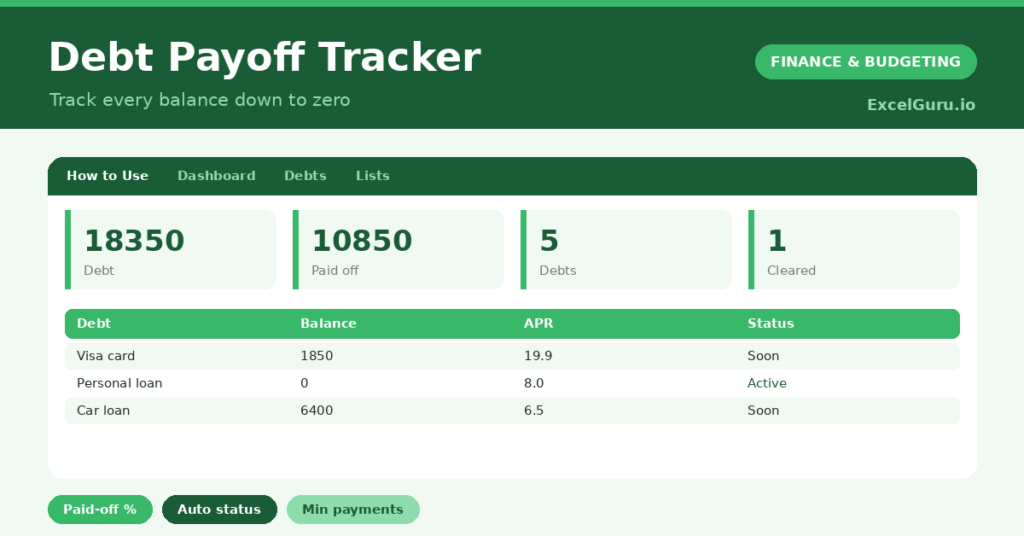
A debt payoff tracker turns the daunting, often demoralising job of clearing debt into visible, motivating progress. When you owe money across several balances, it is hard to feel you are getting anywhere, and that lack of momentum is what makes people give up. So seeing each balance fall, and your total debt shrink, is exactly what keeps you going.
This free template lets you list every debt with its balance, rate and minimum payment, then tracks how much of each you have paid off. So your total debt and your progress are always in view. As a result, the path to debt-free feels concrete rather than overwhelming.
What does the debt payoff tracker include?
The template is one debt list feeding a clear dashboard. A dropdown keeps debt types tidy. In short, you get the following:
- A debt list with the debt, type, original balance, current balance, APR, minimum payment, paid-off percent and status.
- An automatic paid-off percent and a Paid Off or Active status for every debt.
- A dropdown for debt type, from credit cards to loans.
- An APR column, so you can see which debts cost you the most.
- A dashboard showing total debt, your original total, how much you have paid off, your number of debts, those cleared and your total minimum payments.

Which formulas power the debt payoff tracker?
Two formulas track your progress. Each debt’s paid-off percent is =MEDIAN(0, (Original – Current) / Original, 1), which neatly caps the figure between zero and 100% as you pay it down. The status then reads Paid Off once a balance hits zero, and Active until then.
On the dashboard, a SUM of the current balances gives your total debt, while subtracting it from the original total shows how much you have cleared. A COUNTIF counts your paid-off debts, and a SUM totals your minimum payments. So the tracker turns a list of balances into clear, motivating progress.
Why use a debt payoff tracker?
Motivation is the heart of it. Clearing debt is a long haul, and a visible paid-off percentage on each balance gives you the small wins that sustain the effort. So you keep paying rather than losing heart.
It also brings clarity. Seeing every debt in one place, with its balance and APR, helps you decide where to focus, since high-rate debts cost you most. The total-paid-off figure is genuinely encouraging as it grows. Furthermore, knowing your total minimum payments helps you plan your budget around them. In short, the tracker makes becoming debt-free feel achievable, one balance at a time.
What does the dashboard reveal?
The dashboard shows your debt journey at a glance. The total-debt figure is the one to watch fall, and every update is a small victory. So it is the headline of your progress.
The paid-off-so-far figure is deeply motivating, gathering all your hard work into one growing number. The cleared count is a satisfying tally of debts gone for good. The total minimum payments help you plan, since that is the floor your budget must cover. Because it all updates as you pay down balances, your progress stays live. So the dashboard keeps you motivated to the finish.

How do you use it?
List every debt with its original and current balance, its APR and its minimum payment. So you have the full picture in one place. The paid-off percent and status calculate themselves from there.
Then, each time you make a payment, update the current balance, and watch the percentage climb and the total fall. Use the APR column to decide where extra payments do the most good, since high-rate debt is the most expensive. Because every balance feeds the totals, your progress is always honest and visible. In short, update your balances and watch the debt shrink.
How do you customise it?
Edit the debt types on the Lists tab to match yours. Additionally, you can add columns for the lender, the payment due date, or the interest paid so far. Sorting by APR turns it into an avalanche plan, tackling the most expensive debt first. The template suits a single loan or a tangle of cards and balances.
What mistakes should you avoid?
The first mistake is only paying minimums, which barely dents high-interest debt. So put every spare pound toward one target balance. The second mistake is ignoring the APR and paying off the wrong debt first.
The cheapest route is usually to clear the highest-rate debt soonest. Finally, remember this is a tracking tool, not financial advice; a qualified adviser or a free debt charity can help if you are struggling. A debt payoff tracker shows your progress, so let it motivate the consistent payments that actually clear the balances.
Frequently asked questions
How does the debt payoff tracker show progress?
Each debt’s paid-off percentage is the amount cleared divided by the original balance, capped at 100%. The dashboard also shows your total debt falling and how much you have paid off overall.
Should I pay off the highest-rate debt first?
Mathematically, yes: clearing the highest APR first saves the most interest, the avalanche method. Some prefer the snowball, clearing the smallest balance first for motivation. Sorting by APR or balance supports either.
What if I am struggling with debt?
This is a tracking tool, not financial advice. If debt feels unmanageable, a qualified adviser or a free, reputable debt charity can offer real help. There is no shame in reaching out for support.
List your debts, update each balance as you pay, and watch the paid-off percentages climb. The dashboard then shows your total debt falling toward zero. A debt payoff tracker turns a long, hard slog into visible, motivating progress, so becoming debt-free feels achievable one balance at a time.