
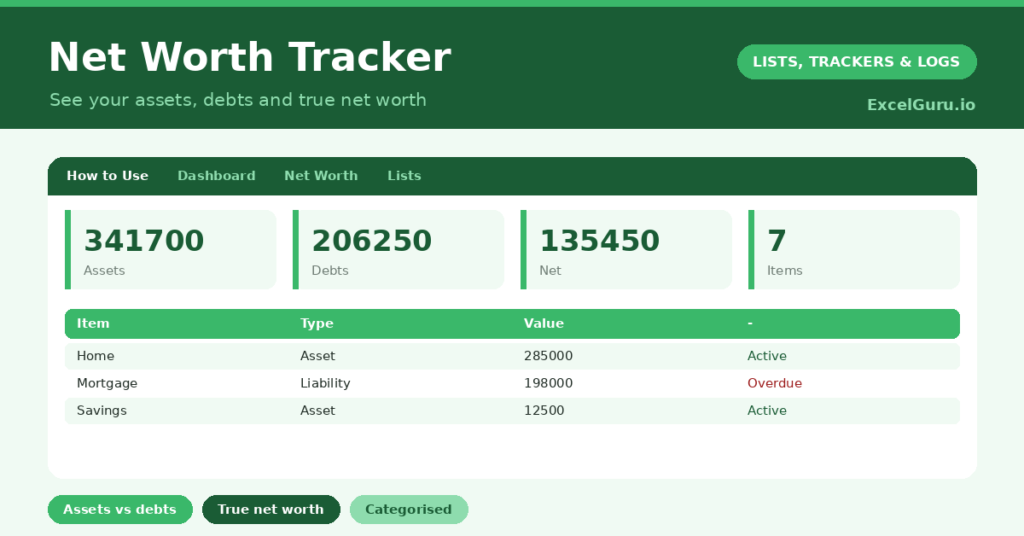
A net worth tracker answers the single most important question in personal finance: are you actually moving forward? Your salary and your savings each tell part of the story, but only net worth, your assets minus your debts, captures the whole picture. So a clear record of what you own and owe is the truest measure of your financial health.
This free template lists your assets and liabilities side by side. So it calculates your true net worth automatically. As a result, you can see exactly where you stand, and, by updating it over time, watch your financial progress in a single, honest number.
What does the net worth tracker include?
The template is one item list feeding a clear dashboard. Dropdowns keep types and categories tidy. In short, you get the following:
- An item list with the item, type, category, value, an as-of date and notes.
- Drop-down lists for type and category, so entries stay consistent.
- Colour-coding that distinguishes assets from liabilities at a glance.
- An as-of-date column, so you can record when each value was accurate.
- A dashboard showing total assets, total liabilities, your net worth, total items, and your counts of assets and liabilities.

Which formulas power the net worth tracker?
The calculation is reassuringly simple. A SUMIF totals the value of everything marked as an Asset, and another SUMIF totals everything marked as a Liability. So your assets and debts are each summed automatically.
Your net worth is then =Total Assets – Total Liabilities, the single figure that matters most. A pair of COUNTIF formulas tally how many assets and liabilities you hold. So the tracker turns a list of accounts and debts into one clear, honest measure of your financial position.
Why keep a net worth tracker?
The first benefit is clarity. Net worth cuts through the noise of income and spending to show whether you are genuinely getting ahead. So it is the truest single gauge of financial progress.
The second benefit is motivation through tracking over time. By updating the figures every month or quarter, you see your net worth trend, and watching it climb is powerfully motivating. It also reveals the impact of paying down debt, not just saving. Furthermore, it is invaluable for big decisions, like a mortgage application. In short, the tracker turns a vague sense of your finances into a clear, trackable number.
What does the dashboard reveal?
The dashboard gives you the whole picture at a glance. The net-worth figure is the headline, and it is the number to watch over time. So it is the one that tells you whether you are moving forward.
The total-assets and total-liabilities figures show the two sides of the balance, which is revealing in itself. Seeing your debts gathered into one figure can be sobering and motivating in equal measure. The item counts show how complete your picture is. Because it all updates as you edit values, your position is always current. So the dashboard makes your finances genuinely visible.

How do you use it?
List everything you own of value, from cash and savings to property, investments and vehicles, marking each as an Asset. So the assets side is complete. Then list everything you owe, such as a mortgage, loans and credit cards, marking each as a Liability.
Enter realistic values and an as-of date, and your net worth appears instantly. The real power comes from updating it regularly, monthly or quarterly, so you can track the trend. Because the figure is always current, you always know where you stand. In short, list it all once, then update the values to watch your progress unfold.
How do you customize it?
Edit the categories on the Lists tab to match your finances. Additionally, you can add columns for the account provider, an interest rate on debts, or a previous value to show the change since last time. Some people keep a new tab each month to build a history. The template suits a simple picture or a detailed, fully itemised balance sheet.
What mistakes should you avoid?
The first mistake is being optimistic with asset values, especially for property or possessions. So use realistic, conservative figures, since an honest net worth is the only useful one. The second mistake is forgetting to include all your debts.
Net worth only means something if both sides are complete, so capture every liability. Finally, do not track it once and forget it. The value lies in updating regularly and watching the trend, so make it a monthly or quarterly habit. A single snapshot is useful; a tracked trend is transformative.
Frequently asked questions
How does the net worth tracker calculate my net worth?
It sums everything marked as an Asset and subtracts everything marked as a Liability, using SUMIF formulas. The result is your true net worth, shown on the dashboard and updated as you edit values.
How often should I update it?
Monthly or quarterly works well. The real value comes from tracking the trend over time, so regular updates let you watch your net worth climb and see the impact of saving and paying down debt.
Should I be conservative with values?
Yes. Use realistic, even cautious, figures for assets like property and possessions. An honest net worth is the only useful one, since the goal is a true picture rather than a flattering one.
List your assets and liabilities, keep the values realistic, and update them regularly. The dashboard then shows your true net worth and how it is trending. A net worth tracker turns the most important question in personal finance into a single, honest number you can watch grow over time.