
Most social media strategies live in fifteen different places. A mission statement sits in a forgotten Google Doc. Competitor research hides in a notebook. Platform goals float in monthly reports nobody reads. You have the pieces, but they never connect into a real plan. When someone asks why you post what you post, you struggle to answer with confidence.
The social media strategic plan template solves this by giving you a single Excel workbook for your entire strategy. You capture your mission, audience, message, SWOT analysis, competitive edge, measurable goals by platform, execution checklist, and tracking metrics. Everything connects. Nothing gets lost.
Also check out Social Media Schedule Template in Excel.
What Is the Social Media Strategic Plan Template?
This template is a structured Excel worksheet for developing, documenting, and executing a complete social media strategy. It serves marketing directors, small business owners, nonprofit teams, agency strategists, and freelance consultants.
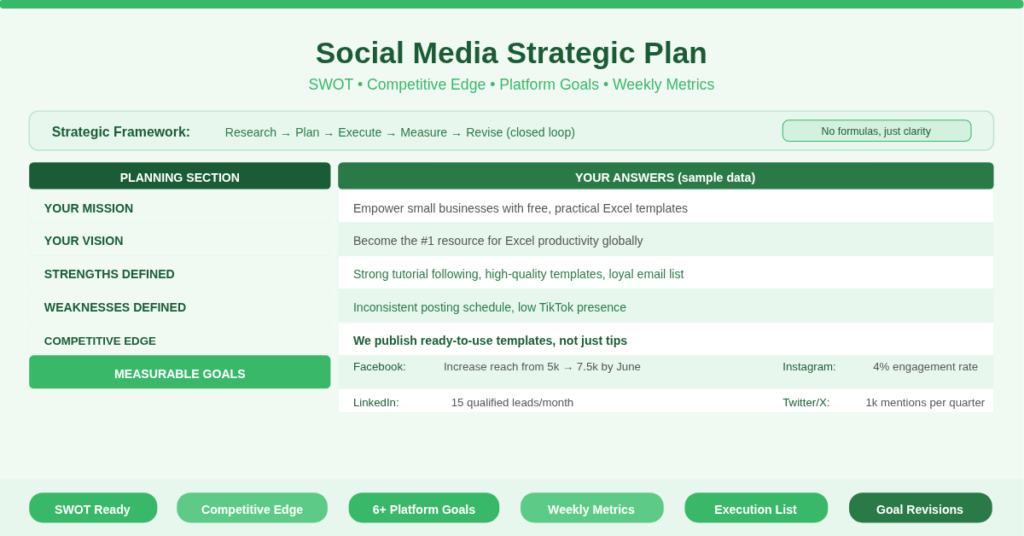
The template organizes your planning into six logical sections:
- Research & Discovery – Mission, vision, target audience, message, strengths, and weaknesses
- Competitive Analysis – Competitor identification, their strengths, your competitive edge, and differentiators
- Plan Building – Objectives, measurable goals per platform (Facebook, Twitter, LinkedIn, YouTube, Instagram, Snapchat)
- Execute & Implement – Message uniformity, graphic consistency, conversation monitoring, daily posting, and reporting
- Measure & Track – Weekly status updates, network growth, engagement metrics, influence tracking, and what’s working evaluations
- Goal Assessment – Revised and new goals per platform
Each section provides prompts, not blank pages. You fill the right column with your specific answers. Consequently, you move from fuzzy thinking to clear action steps.
Complete SWOT and Competitive Edge Analysis
The social media strategic plan template includes dedicated rows for STRENGTHS DEFINED and WEAKNESSES DEFINED. These are not afterthoughts. They sit immediately after your message and audience, forcing you to ground your strategy in reality.
Similarly, the competitive analysis section asks four critical questions:
- COMPETITION DEFINED (who exactly are you up against?)
- COMPETITION STRENGTHS (what do they do well?)
- YOUR COMPANY’S COMPETITIVE EDGE (what you do better)
- WHAT YOUR COMPANY CAN DO DIFFERENTLY
Here is why this matters. Without a clear competitive edge, your social content blends into the noise. The template makes you articulate that edge in plain words. A bakery might write: “We post daily behind-the-scenes videos of fresh baking, while competitors post only product photos.” That single sentence shapes every Instagram Reel and Facebook post for the next six months.
Platform-Specific Measurable Goals Without the Fluff
Many strategic plans list generic goals like “increase engagement” or “grow followers.” Those are wishes, not goals. This template demands specificity by providing a row for each major platform: Facebook, Twitter, LinkedIn, YouTube, Instagram, and Snapchat.
You write a measurable goal next to each platform. For example:
- Facebook – “Increase weekly reach from 5,000 to 7,500 by June 30”
- LinkedIn – “Generate 15 qualified lead inquiries per month from thought leadership posts”
- Instagram – “Achieve 4% engagement rate (likes + comments/impressions) on Reels”
Because the goals sit side by side, you immediately see gaps. If YouTube has no goal but video is your priority, the template reveals that inconsistency. Furthermore, the template includes a second goal assessment section later, so you revisit and revise these numbers after tracking actual performance.
The Execute-Implement-Launch Checklist
Plans fail at execution, not conception. The template includes a dedicated EXECUTE – IMPLEMENT – LAUNCH section with five concrete checkpoints:
- Check for message clarity and uniformity across platforms
- Graphic uniformity (colors, fonts, logo usage)
- Conversation monitoring (who responds and when)
- Social ID added to all branding including email and print media
- Daily posting where applicable
Each checkpoint acts as a yes/no audit. You cannot launch until every item checks out. Moreover, the section includes a REPORTING PLAN prompt for engagement, influence, and numbers. This forces you to decide, before launch, what success looks like and how you will measure it.
How Does the Weekly Status Update System Work?
The MEASURE – METRICS – TRACK section contains three rolling trackers:
- NUMBER / NETWORK GROWTH – Track follower counts per platform weekly
- STATUS: ENGAGEMENT – Record likes, comments, shares, and saves
- STATUS: INFLUENCE – Monitor mentions, shares from key accounts, and referral traffic
You update these every week in the blank cells next to each label. The template does not need formulas because strategic tracking is qualitative and quantitative mixed. Instead, you write numbers or short status notes. For example: “Engagement up 12% this week due to the Reel series.”
After four weeks, you review the WHAT’S WORKING? WHAT ISN’T? EVALUATION AND REVISIONS section. You write two short paragraphs. Then you move to GOAL ASSESSMENT – REVISED GOALS – NEW GOALS, where you adjust your original platform targets based on real data. This closed-loop system transforms the template from a static document into a living strategic tool.
Practical Use Cases for Different Professionals
Marketing Director at a Mid-Sized Company – Use the template to align your team of four social media managers. Assign each manager one platform section. The mission and competitive edge sections become your onboarding document for new hires.
Small Business Owner – Spend two hours filling the template once per quarter. The SWOT analysis reveals why your Instagram Reels outperform your Facebook posts. The execution checklist prevents you from launching without a monitoring plan.
Nonprofit Communications Lead – Adapt the template for donor engagement and volunteer recruitment. Replace “competitive edge” with “community differentiators.” The measurable goals section helps you prove impact to your board using platform-specific metrics like LinkedIn shares of success stories.
Agency Strategist – Duplicate the template tab for each client. Use the competitive analysis section to pitch new differentiators during quarterly business reviews. The “what can we do differently” row becomes your innovation log.
Freelance Content Creator – Treat the template as your personal brand strategy. The strengths and weaknesses section helps you decide which platforms to drop (e.g., Snapchat) and which to double down on (e.g., TikTok, by adding a custom row). The weekly status update keeps you accountable when you have no external boss.
How to Set Up and Start Using the Template
Follow these steps to complete your strategic plan:
- Download the Excel file from the link below
- Open the file and review all six sections from RESEARCH to GOAL ASSESSMENT
- Start with YOUR MISSION – write one sentence (e.g., “To help small businesses master Excel”)
- Move to YOUR VISION – write where you want to be in three years
- Complete TARGET AUDIENCE, YOUR MESSAGE, STRENGTHS, and WEAKNESSES in one sitting
- Research two direct competitors and fill COMPETITION DEFINED and their STRENGTHS
- Write YOUR COMPANY’S COMPETITIVE EDGE – this is your strategic north star
- Set one measurable goal for each platform in the MEASURABLE GOALS section
- Work through the EXECUTE checklist – mark each item as complete or not started
- Schedule a 30-minute weekly review to update the STATUS sections and revise goals monthly
Keep the template open on your desktop during your weekly social media meeting. Use it as the agenda: review engagement status, discuss what’s working, and adjust next week’s tactics accordingly.
Download Your Free Social Media Strategic Plan Template
Stop juggling disconnected documents and start executing with a unified plan. Download the free social media strategic plan template below. It works with Excel 2016, 2019, 365, and Google Sheets. No macros, no complex formulas – just a clear framework that turns strategy into action.